
Course
NR546 Advanced Pharmacology: Psychopharmacology for Psychiatric-Mental Health Nurse Practitioner
Requirements
Follow these guidelines when completing each component of the assignment. Contact your course faculty if you have questions.
General Instructions
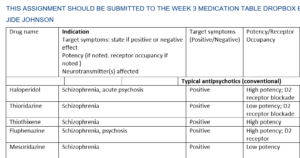
Download the Week 3 Medication Table Download Week 3 Medication TableOpen this document with ReadSpeaker docReader and complete the required information using the template.
Include the following sections (detailed criteria listed below and in the grading rubric)
- For each medication listed, complete the following:
- Provide indication, target symptoms, potency, and affected neurotransmitters.
- Include half-life and CYP 450 enzyme information.
- List notable side effects.
- Link notable side effects to the associated pathway or neurotransmitter.
How to Approach This Assignment
This assignment focuses on your ability to connect pharmacology, pathophysiology, and clinical application.
To complete the table accurately:
Indication & Target Symptoms
Identify the FDA-approved indication(s).
Clarify which specific psychiatric symptoms the medication addresses.
Differentiate between primary and off-label uses when applicable.
Potency & Neurotransmitter Effects
Identify whether the medication is high, moderate, or low potency (if applicable).
Explain which neurotransmitters are affected (e.g., dopamine, serotonin, norepinephrine).
Specify receptor targets (D2, 5-HT2A, etc.) when relevant.
Half-Life & CYP 450 Information
Include elimination half-life (short vs. long-acting).
Identify major CYP enzymes involved (e.g., CYP2D6, CYP3A4).
Note potential drug interactions related to enzyme metabolism.
Notable Side Effects
List clinically significant side effects (not every minor reaction).
Include:
Extrapyramidal symptoms (EPS)
Weight gain
Sedation
QT prolongation
Sexual dysfunction
Metabolic changes
Link Side Effects to Pathways
This is where many students lose points.
You must explain:
Dopamine blockade → EPS, hyperprolactinemia
Histamine blockade → sedation, weight gain
Muscarinic blockade → dry mouth, constipation
Serotonin effects → sexual dysfunction
Alpha-1 blockade → orthostatic hypotension
This demonstrates understanding beyond memorization.
Key Concepts to Focus On
Receptor pharmacodynamics
Mechanism of action
Metabolic pathways
Drug-drug interactions
Neurotransmitter-pathway relationships
Clinical safety considerations
Sample solution
Click below to access the full sample solution (PDF)