
Course
NR546 Advanced Pharmacology: Psychopharmacology for Psychiatric-Mental Health Nurse Practitioner
Preparing the Assignment
Follow these guidelines when completing each component of the assignment. Contact your course faculty if you have questions.
General Instructions
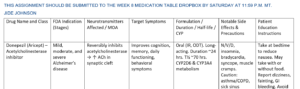
Download the Week 8 Medication Table Download Week 8 Medication TableOpen this document with ReadSpeaker docReader and complete the required information using the template.
Include the following sections (detailed criteria listed below and in the grading rubric)
- For each medication listed, complete the following:
- Provide FDA Indication (include stages), neurotransmitters Affected/Mechanism of Action, and Target Symptoms.
- Include formulation (Short-acting, intermediate-acting, or long-acting), duration of action, half-life, and CYP 450 enzyme information.
- List notable side effects and precautions.
- Include Patient Education Instructions.
How to Approach This Assignment
1. Review Each Medication Individually
Research each drug separately.
Use primary sources such as FDA labeling, clinical guidelines, and peer-reviewed literature.
2. Clarify FDA Indication
Identify approved uses and stages of disease (if applicable).
Avoid listing off-label uses unless clearly specified.
3. Understand Mechanism of Action
Identify neurotransmitters affected (if psychiatric or neurologic medication).
Clearly explain how the drug works at the receptor or cellular level.
Connect mechanism to symptom improvement.
4. Include Pharmacokinetics
Be precise and organized when listing:
Formulation type (short-, intermediate-, long-acting)
Duration of action
Half-life
CYP450 metabolism (which enzymes inhibit or induce the drug)
5. Address Safety and Precautions
List common side effects.
Highlight serious adverse effects.
Include black box warnings if applicable.
Note contraindications and high-risk populations.
6. Develop Patient Education
Focus on adherence instructions.
Address safety warnings (e.g., sedation, bleeding risk, serotonin syndrome).
Include guidance on when to contact a provider.
7. Organize Clearly in the Table
Keep entries concise but detailed.
Use professional language.
Ensure information aligns with rubric requirements.
Key Concepts to Focus On
FDA-approved indications and disease stages
Mechanism of action and neurotransmitter effects
Pharmacokinetics (half-life, duration, CYP450 metabolism)
Side effects and black box warnings
Drug-drug interactions
Patient education and safety monitoring
Evidence-based pharmacologic decision-making
Sample Solution
Click below to access the full sample solution (PDF)