NR565 Assignment Week 6: Respiratory Protocol Assignment


Course
 NR565 Advanced Pharmacology Fundamentals

Section 1: Pharmacological Treatment
Questions:
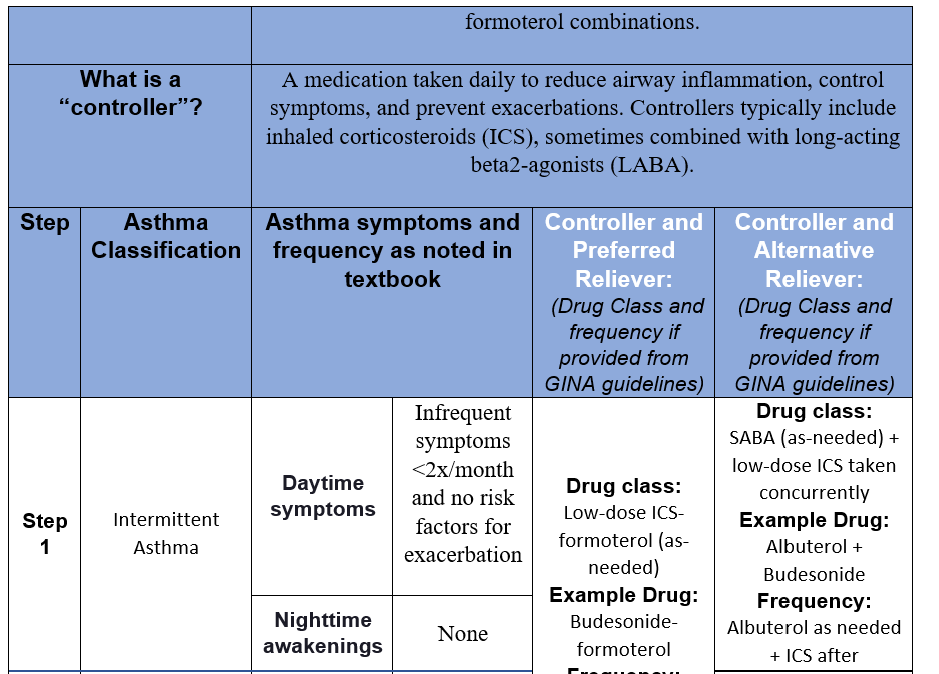
  1. Correctly complete all blanks for the preferred and alternative medication for each step of therapy noted in the CPG.
  2. List medications in order according to the CPG.
  3. List generic medication names for each category.
  4. Provide an in-text citation under the completed table.
How to Approach These Questions:
  • Open your Asthma Clinical Practice Guideline (CPG) first.
  • Locate the stepwise treatment table for asthma management.
  • Fill the template step-by-step:
    • Start with Step 1 (mild asthma).
    • Add the preferred medication listed.
    • Add the alternative medication listed.
    • Continue this same pattern through all steps (Step 2–Step 5).
  • Make sure:
    • Medications are listed in correct order from Step 1 to highest step.
    • Only generic names are used (not brand names).
  • After finishing the table:
    • Add one in-text citation under the table from your guideline.

Section 2: Treatment Differences in Adults and Children
Questions:
  1. Correctly list the first line of initial pharmacologic treatment in Step 1; Track 1 for asthmatic adults (7a on the form).
  2. Correctly list the first line of initial pharmacologic treatment in Step 1; Track 1 for asthmatic children ages 6–11 (7b on the form).
  3. Correctly list drug dose, route, frequency, instructions, precautions, drug cost, and education for adult and pediatric clients.
  4. Provide in-text citations under the information for adults and pediatric clients.
How to Approach These Questions:
  • Find Step 1, Track 1 in your asthma guideline.
  • Identify the first-line medication recommended.
For Adults:

Fill in:

  • Drug name
  • Dose
  • Route (usually inhalation)
  • Frequency
  • Instructions (how often and when to use)
  • Precautions (side effects or warnings)
  • Drug cost (low, moderate, or high)
  • Patient education (how to use inhaler correctly)

Use:

  • CPG → medication recommendation
  • Textbook → dosing and education details
For Children (Age 6–11):

Repeat the same process:

  • Use pediatric dosing (not adult dose).
  • Verify dose carefully using guideline or textbook.
  • Include education specific to children and caregivers.

Don’t forget:

  • Add in-text citations under both adult and pediatric sections.

Section 3: Treatment Monitoring
Questions:
  1. List the physical assessments required for monitoring the first-line medications prescribed to adults for Track 1, Step 1.
  2. List the pulmonary function tests required for monitoring the first-line medications prescribed to adults for Track 1, Step 1.
  3. List the laboratory tests required for monitoring the first-line medications prescribed to adults for Track 1, Step 1.
  4. Provide an in-text citation under the treatment monitoring section.
How to Approach These Questions:

Focus only on:

Adult Step 1 Track 1 medication

Physical Assessments:

Look for common respiratory monitoring signs such as:

  • Respiratory rate
  • Breath sounds
  • Wheezing
  • Oxygen saturation
  • Shortness of breath symptoms
Pulmonary Function Tests:

Typical tests include:

  • Spirometry
  • Peak Expiratory Flow Rate (PEFR)
Laboratory Tests:

Not always required, but may include:

  • Allergy testing
  • Blood eosinophil count
  • IgE levels (if needed)

Add:

  • One in-text citation under this section.

Section 4: Treatment Failure
Questions:
  1. Describe how you will know that treatment is not working or needs to progress.
  2. Describe the next step if treatment is not working or needs to progress.
  3. Describe the indicators that would demonstrate that the client requires a higher level of care.
  4. Provide an in-text citation under the treatment failure section.
How to Approach These Questions:
Question 1: How will you know treatment is not working?

Look for signs such as:

  • Persistent asthma symptoms
  • Frequent rescue inhaler use
  • Nighttime asthma symptoms
  • Reduced lung function
  • Frequent asthma attacks
Question 2: What is the next step?

Follow:

Step-Up Therapy

Meaning:

  • Move to the next step in the asthma treatment plan.
  • Increase medication intensity or dose.
  • Add another controller medication if needed.

Always follow what the guideline recommends.

Question 3: When is higher-level care required?

Look for serious warning signs such as:

  • Severe breathing difficulty
  • Poor oxygen levels
  • No response to medication
  • Signs of respiratory distress
  • Need for emergency treatment or hospitalization

Sample Solution
  • RATIONALE
    1. This protocol will assist in the differentiation between treatment needs for clients with asthma based on age and symptom frequency and severity, including the process for identification of clients in need of referral to pulmonology to improve asthma control. The design of the protocol for asthma encompasses these principles.……..Please click the icon below to access the discussion.