
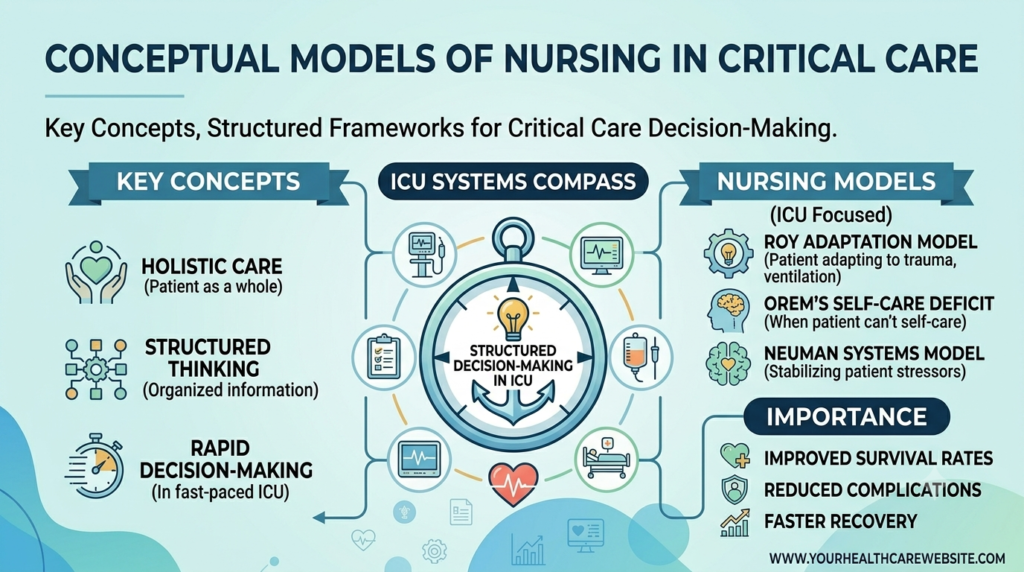
Conceptual models of nursing in critical care provide structured frameworks that guide how nurses understand, assess, and manage patients in highly complex and high-risk environments such as Intensive Care Units (ICUs). These models help nurses organize care for critically ill patients who often have life-threatening conditions requiring continuous monitoring, rapid decision-making, and advanced interventions.
In critical care settings, patients experience rapid changes in health status, and care must be highly coordinated. Conceptual models support nurses in maintaining a systematic approach to care by focusing on the relationship between the patient, environment, health status, and nursing interventions. They improve clinical judgment and ensure care remains patient-centered even in high-pressure situations.
What Are Conceptual Models of Nursing?
Conceptual models of nursing are broad frameworks that describe how nursing care should be organized and understood. They provide a general structure for thinking about patient care and guide nursing practice, education, and research. These models help nurses understand how different concepts such as health, environment, and human responses are connected.
In critical care, conceptual models are especially important because they support holistic thinking in fast-paced environments. Instead of focusing only on medical diagnoses, nurses use these models to consider physical, emotional, psychological, and environmental factors that influence patient outcomes.
Key Features of Conceptual Models in Critical Care
- Holistic Approach
Focus on the whole patient, not just the illness or organ system. - Structured Thinking
Provide a clear framework for organizing complex patient information. - Guidance for Decision-Making
Support clinical judgment in rapidly changing situations. - Integration of Care Factors
Combine physical, emotional, social, and environmental aspects of health. - Foundation for Evidence-Based Practice
Help nurses apply research-based interventions in ICU care.
Common Conceptual Models Used in Critical Care
1. Roy Adaptation Model
Callista Roy developed the Adaptation Model, which is widely used in critical care settings. It views patients as adaptive systems that respond to internal and external changes. In ICUs, this model helps nurses assess how patients adapt to mechanical ventilation, trauma, or organ failure and support their recovery through targeted interventions.
2. Orem’s Self-Care Deficit Model
Dorothea Orem developed the Self-Care Deficit Theory, which is useful in critical care when patients are unable to care for themselves due to severe illness or sedation. Nurses provide complete care while also identifying opportunities to restore independence as patients improve.
3. Neuman Systems Model
Betty Neuman introduced the Systems Model, which views patients as open systems affected by stressors. In critical care, this model helps nurses identify physiological, psychological, and environmental stressors and implement interventions to stabilize patient systems and prevent complications.
4. Watson’s Theory of Human Caring
Jean Watson developed the Theory of Human Caring, which emphasizes compassion and therapeutic relationships. In critical care units, where patients may be unconscious or highly vulnerable, this model supports dignity, empathy, and family-centered care.
Application of Conceptual Models in Critical Care Practice
In critical care nursing, conceptual models are applied during patient assessment, planning, intervention, and evaluation. Nurses use these models to interpret complex clinical data, prioritize life-saving interventions, and maintain a holistic view of patient needs. For example, while managing a ventilated patient, nurses consider not only oxygenation status but also emotional stress, family involvement, and environmental factors such as noise and lighting in the ICU.
These models also support teamwork and communication in multidisciplinary critical care teams. By using a shared framework, nurses, physicians, and other healthcare professionals can coordinate care more effectively. This leads to improved patient safety, reduced complications, and better overall outcomes in intensive care settings.
Importance of Conceptual Models in Critical Care
- Provide structure in highly unpredictable critical care environments
- Help nurses stay organized when managing multiple complex patients
- Enhance critical thinking in fast-paced clinical situations
- Support comprehensive assessment of patient needs
- Improve clinical decision-making based on structured frameworks
- Promote consistency in care delivery across healthcare teams
- Support evidence-based nursing practice
- Encourage holistic patient care (physical, emotional, and psychological needs)
- Improve patient survival rates in critical care settings
- Reduce complications in critically ill patients
- Support faster and safer patient recovery in ICU environments