
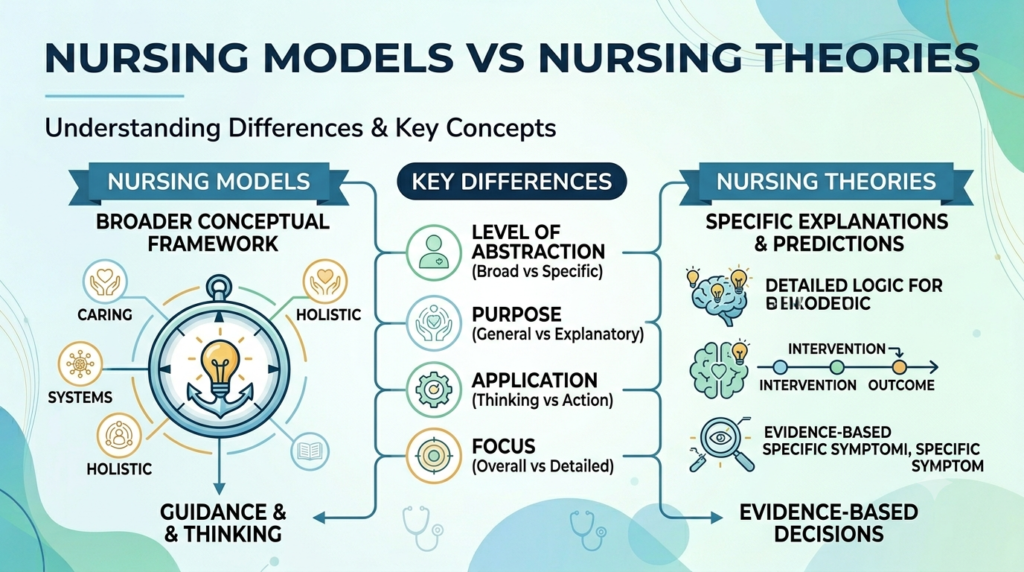
Nursing models and nursing theories are both essential in guiding nursing practice, education, and research. They help nurses understand patient care, organize knowledge, and improve decision-making in clinical settings. Although they are closely related and often used together, they are not the same. Understanding the difference between nursing models and nursing theories helps clarify how nursing knowledge is structured and applied in practice.
Both nursing models and theories provide frameworks for thinking about health, patients, and care delivery. However, they differ in purpose, level of abstraction, and how directly they are applied in clinical settings. Nursing models are broader conceptual structures, while nursing theories are more specific explanations of nursing phenomena.
What Are Nursing Theories?
Nursing theories are structured ideas that explain, describe, or predict nursing practice and patient care. They focus on specific concepts such as patient needs, health conditions, nursing interventions, and outcomes. Theories help nurses understand why certain care approaches work and guide evidence-based decision-making in clinical practice.
Nursing theories can be broad or specific depending on their type (grand, middle-range, or practice-level). They are often developed through research and clinical experience and are used to improve patient care quality, support nursing education, and guide professional practice.
What Are Nursing Models?
Nursing models are conceptual frameworks that provide a broader view of nursing practice. They are used to organize ideas about health, patients, environment, and nursing care into a structured system. Nursing models help nurses understand how different concepts in healthcare are connected.
Unlike theories, nursing models are often more abstract and are not always designed to explain specific nursing actions. Instead, they provide a general structure that helps guide thinking, teaching, and the development of nursing theories. Examples include models that focus on holistic care, patient-centered care, or health promotion.
Key Differences Between Nursing Models and Nursing Theories
- Level of Abstraction
Nursing models are more abstract and broad, while nursing theories are more focused and detailed. - Purpose
Models provide a general framework for understanding nursing, while theories explain specific nursing concepts or phenomena. - Application
Models are mainly used for organizing knowledge and guiding thinking, while theories are directly applied in clinical practice and research. - Development
Nursing models often form the foundation for developing nursing theories. - Focus
Models focus on the overall structure of nursing, while theories focus on explaining relationships and predicting outcomes.
Relationship Between Nursing Models and Theories
Nursing models and theories are closely connected and often depend on each other. Nursing models provide the broad structure or framework, while nursing theories are developed within that structure to explain specific aspects of care. In many cases, a nursing theory is derived from a nursing model, or a model is used to organize several related theories.
Together, they help nurses understand both the big picture and the detailed aspects of patient care. This combination supports holistic, evidence-based, and patient-centered nursing practice in real clinical environments.
Importance in Nursing Practice
Understanding the difference between nursing models and theories is important for effective nursing practice. It helps nurses choose appropriate frameworks for patient care, improve clinical reasoning, and apply knowledge in a structured way. Nursing models support long-term thinking and care organization, while theories guide day-to-day clinical decisions.
In practice, both are used together to improve patient outcomes. Nurses rely on models to understand the overall structure of care and use theories to guide specific interventions. This integration ensures that nursing care is both scientifically grounded and practically effective.