
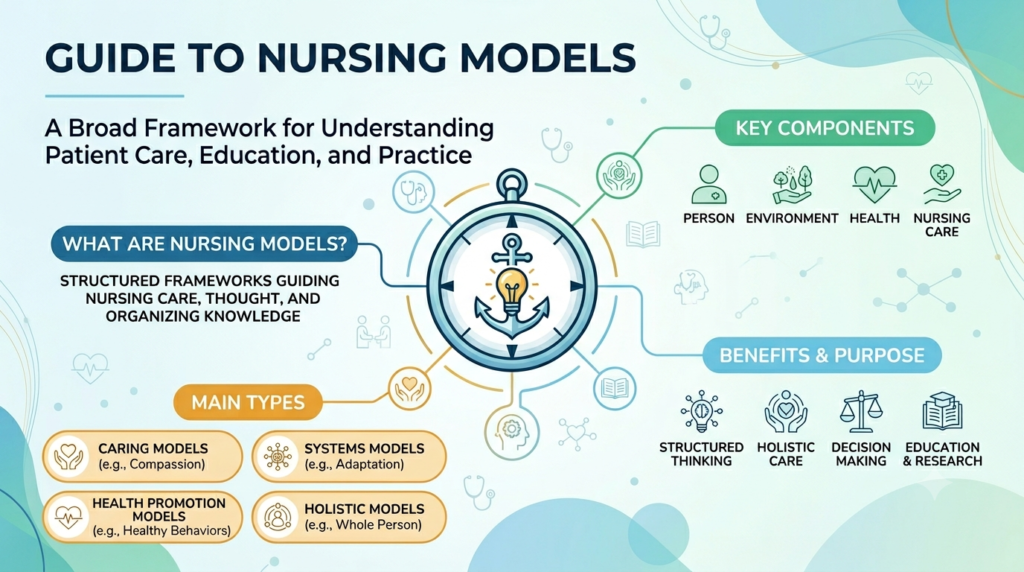
Nursing models are structured frameworks that help explain how nursing care is delivered and how different elements of healthcare are connected. They provide a broad way of thinking about patients, health, environment, and nursing actions. Nursing models are used in education, practice, and research to guide nurses in understanding patient needs and organizing care in a systematic way.
Unlike nursing theories, which focus on specific explanations or predictions, nursing models offer a wider perspective. They help nurses see the “big picture” of care and provide a foundation for developing nursing theories and improving clinical decision-making.
What Are Nursing Models?
Nursing models are conceptual frameworks that describe the relationship between key components of nursing, such as the patient, environment, health, and nursing care. They help organize nursing knowledge into a structured system that guides thinking and practice.
These models are not always focused on specific nursing actions. Instead, they provide general guidance on how nurses should view patients and deliver care. Nursing models are often used to shape nursing education, support communication among healthcare professionals, and guide the development of nursing theories.
Key Features of Nursing Models
- Broad Perspective
Nursing models provide a wide and general view of nursing practice rather than focusing on specific tasks. - Conceptual Framework
They organize important nursing concepts such as person, health, environment, and nursing. - Guidance for Practice
They help nurses understand how to approach patient care in a structured and holistic way. - Foundation for Theories
Many nursing theories are developed from or influenced by nursing models. - Focus on Holistic Care
Nursing models emphasize caring for the whole person, not just the disease.
Types of Nursing Models
1. Caring Models
These models focus on compassion, empathy, and the nurse-patient relationship. They emphasize emotional support and human connection in healthcare.
2. Systems Models
These models view patients as part of a system influenced by internal and external factors. They focus on balance, interaction, and adaptation.
3. Health Promotion Models
These models focus on encouraging healthy behaviors and preventing illness. They support patient education and lifestyle improvement.
4. Holistic Models
These models consider the whole person, including physical, emotional, social, and spiritual needs. They emphasize comprehensive care.
Importance of Nursing Models
Nursing models are important because they provide a structured way of understanding patient care. They help nurses organize complex information and make better clinical decisions. By using nursing models, nurses can deliver more consistent, patient-centered, and effective care.
Nursing models also support education and research by providing a foundation for learning and developing new theories. They help students understand how nursing concepts are connected and how care should be approached in real clinical settings. In practice, they promote holistic care and improve communication among healthcare professionals.
Nursing Models in Practice
In clinical practice, nursing models are used to guide how nurses assess patients, plan care, and evaluate outcomes. They help nurses view patients as whole individuals rather than focusing only on diseases or symptoms. This ensures that care includes physical, emotional, social, and environmental factors.
Nurses also use models to improve teamwork and communication in healthcare settings. By following a shared framework, healthcare professionals can work together more effectively. Nursing models help ensure that care is organized, consistent, and focused on improving patient well-being and recovery.
Conclusion
Nursing models are essential tools in nursing that provide a broad framework for understanding patient care. They help organize nursing knowledge, support holistic care, and guide both education and clinical practice. By using nursing models, nurses can improve decision-making and deliver high-quality, patient-centered care.