
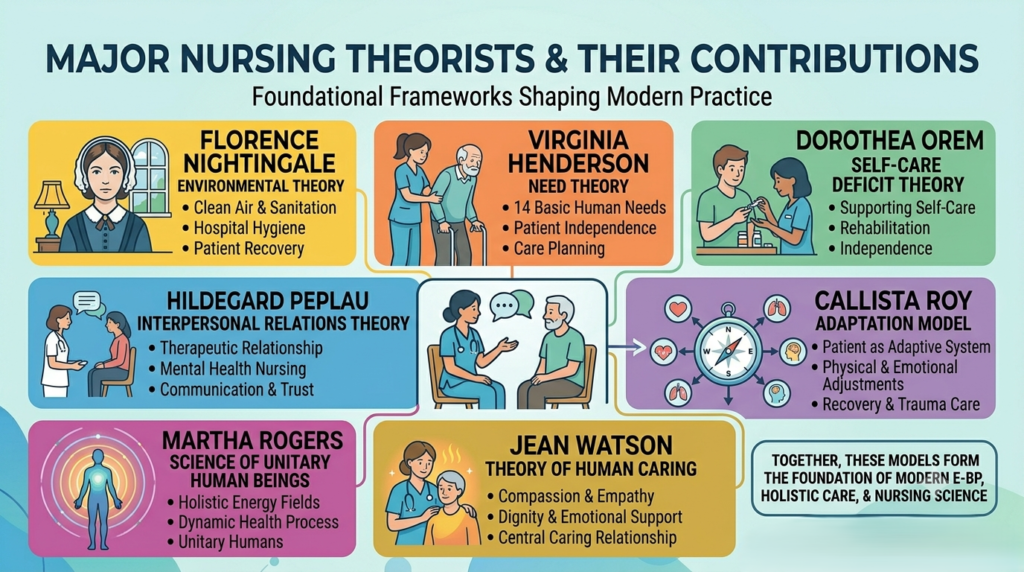
Nursing theories were developed by key scholars to explain and guide nursing practice. These theorists helped establish nursing as a scientific profession with its own body of knowledge. Their ideas continue to shape modern nursing education, clinical practice, and research by providing frameworks for patient care, communication, and decision-making.
Each theorist offers a unique perspective on health and healing. Together, their work forms the foundation of evidence-based nursing practice and supports holistic patient care in different healthcare settings.
Florence Nightingale — Environmental Theory
Florence Nightingale developed the Environmental Theory, which emphasizes the importance of a clean and safe environment in promoting patient recovery. She believed that factors such as fresh air, clean water, proper sanitation, lighting, and quiet surroundings directly affect health outcomes.
Her work laid the foundation for modern infection control and hospital hygiene practices. Today, her ideas are applied in patient safety, environmental health, and healthcare facility design.
Virginia Henderson — Need Theory
Virginia Henderson defined nursing as assisting individuals in performing activities that contribute to health, recovery, or peaceful death. She identified 14 basic human needs that nurses help patients meet when they cannot do so independently.
Her theory is widely used in nursing care planning and emphasizes patient independence. The goal of nursing, according to Henderson, is to help patients become self-sufficient as quickly as possible.
Dorothea Orem — Self-Care Deficit Theory
Dorothea Orem introduced the Self-Care Deficit Theory, which explains that nursing care is needed when individuals are unable to care for themselves. She focused on the importance of supporting patients in developing or maintaining self-care abilities.
This theory is commonly used in rehabilitation, chronic illness care, and patient education. It helps nurses assess patient limitations and design care plans that encourage independence.
Hildegard Peplau — Interpersonal Relations Theory
Hildegard Peplau developed the Interpersonal Relations Theory, which focuses on the therapeutic relationship between nurse and patient. She believed communication, trust, and interaction are essential parts of the healing process.
This theory is especially important in mental health nursing, where building strong nurse-patient relationships improves treatment outcomes and emotional well-being.
Callista Roy — Adaptation Model
Callista Roy created the Adaptation Model, which views patients as individuals who must adapt to changes in health and environment. Nursing, in this model, helps patients adjust physically, emotionally, and socially to health challenges.
It is widely applied in both acute and chronic care settings, helping nurses support patients through illness, disability, and recovery.
Martha Rogers — Science of Unitary Human Beings
Martha Rogers proposed that humans are energy fields in constant interaction with their environment. She viewed health as a dynamic process influenced by energy and environmental exchange rather than just physical conditions.
Her theory encourages holistic care, focusing on the patient as a whole rather than just treating disease.
Jean Watson — Theory of Human Caring
Jean Watson developed the Theory of Human Caring, which emphasizes compassion, empathy, and human connection in nursing. She believed that caring relationships are central to healing and should be the core of nursing practice.
Her theory is widely used in modern healthcare to promote patient dignity, emotional support, and holistic care.
Conclusion
Major nursing theorists have shaped the way nursing is practiced today. Their theories provide structured approaches to patient care, improve clinical decision-making, and support holistic treatment. Understanding their contributions helps nurses apply theory in practice and deliver high-quality, evidence-based care.