
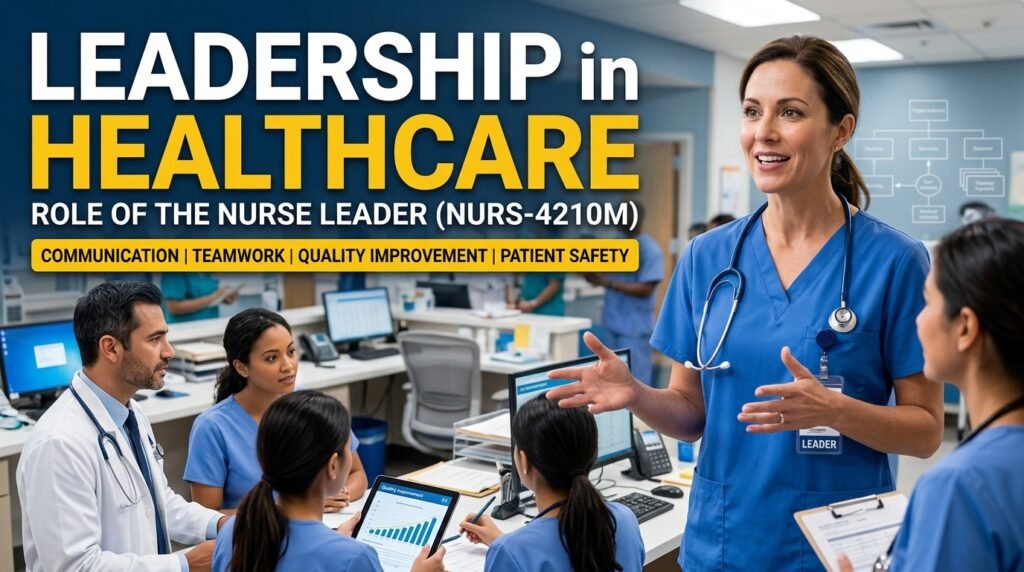
This course explores the role of the nurse leader in healthcare organizations and focuses on leadership, communication, collaboration, decision-making, quality improvement, evidence-based practice, and professional development. It examines how nurse leaders influence healthcare teams, promote effective communication, manage conflict, support patient safety, and lead organizational change. The course also emphasizes the importance of ethical leadership, interprofessional collaboration, accountability, and using evidence to improve nursing practice and patient outcomes.
Course activities:
NURS-4210M Week 1: Practicum – Role of the Nurse Leader in Population Health – Group C
NURS-4210M Week 1: Discussion Community Health Issues
NURS-4210M Week 2: Discussion An Epidemic in the Community
NURS-4210M Week 2: Practicum – Role of the Nurse Leader in Population Health – Group C
NURS-4210M Week 3: Discussion Evaluating Culture From the Nursing Perspective
NURS-4210M Week 3: Practicum – Role of the Nurse Leader in Population Health – Group C
NURS-4210M Week 4: Discussion Disaster Planning
NURS-4210M Week 4: Practicum – Role of the Nurse Leader in Population Health – Group C
Course Goal
The goal of this course is to develop competent and effective nurse leaders who can apply leadership principles to improve nursing practice and healthcare outcomes. Students develop skills in communication, critical thinking, decision-making, delegation, conflict management, team building, and change management. The course prepares nurses to lead diverse healthcare teams, advocate for patients and staff, promote quality improvement and patient safety, and use evidence-based strategies to address challenges within healthcare organizations. It also aims to strengthen professional accountability, ethical leadership, collaboration, and the ability to create sustainable improvements in healthcare delivery.