
Topic: Antidepressants
Antidepressants are medications used to manage depression and several other mental health conditions. They work by influencing neurotransmitter activity in the brain, helping improve symptoms such as persistent sadness, loss of interest, anxiety, and changes in sleep or appetite.
One of the most common questions patients ask when starting treatment is how long antidepressants take to work. Unlike medications that provide immediate symptom relief, antidepressants generally require several weeks before their full therapeutic benefits become noticeable.
Understanding the expected treatment timeline helps patients develop realistic expectations, recognize early improvements, and remain consistent with their medication. For psychiatric-mental health nurse practitioners (PMHNPs), explaining this process is an important part of medication management and patient education.
How Long Do Antidepressants Take to Work?
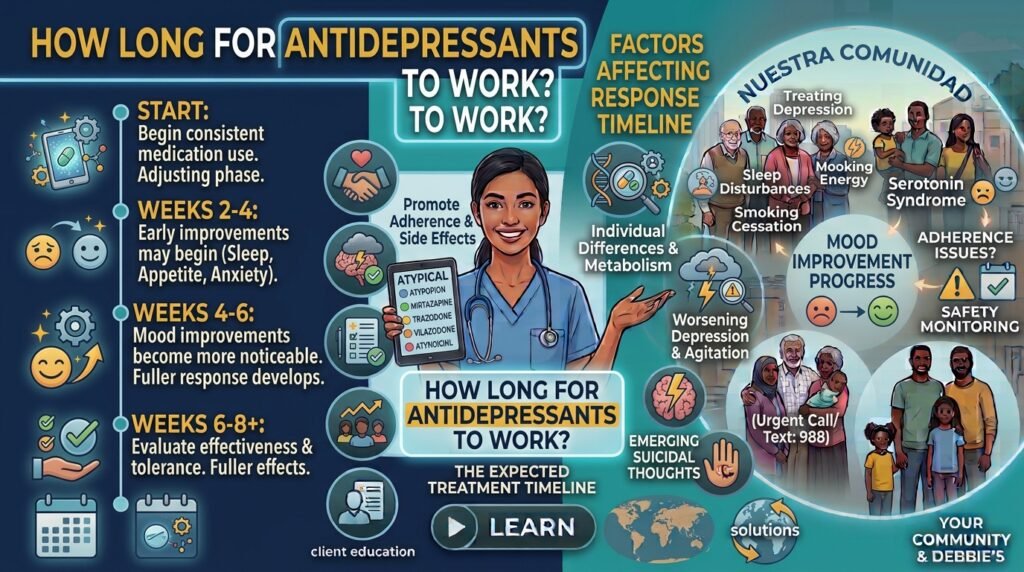
Most antidepressants begin producing noticeable improvements within two to four weeks, although some patients may need six to eight weeks or longer to experience their full therapeutic benefits.
The timeline varies depending on the medication, the patient’s condition, dosage, individual response, and other clinical factors.
Some patients notice improvements in sleep, appetite, energy, or anxiety before experiencing significant changes in mood. Others may not notice meaningful improvement until several weeks into treatment.
It is important to understand that early changes do not necessarily mean the medication has reached its full effectiveness.
What Happens After Starting Antidepressants?
Antidepressant treatment involves gradual changes in neurotransmitter signaling and the brain’s adaptive responses. Different symptoms may improve at different stages.
First Week: Initial Medication Effects
During the first week, the body begins adjusting to the medication.
Some patients may experience:
- Mild nausea or gastrointestinal discomfort.
- Headaches.
- Changes in sleep patterns.
- Dizziness.
- Increased restlessness or temporary anxiety.
- Changes in appetite.
These effects do not necessarily indicate whether the medication will be effective.
Some patients may notice early changes in sleep or anxiety, but significant improvement in depressive symptoms is not usually expected this soon.
Weeks Two to Four: Early Symptom Improvement
During this period, some patients begin noticing meaningful changes.
Possible improvements include:
- Better sleep quality.
- Improved appetite.
- Reduced anxiety or emotional distress.
- Increased energy.
- Improved concentration.
- Gradual improvement in mood.
However, responses vary. Some patients may still experience significant depressive symptoms during this stage.
Weeks Four to Six: More Noticeable Improvement
For many patients, improvements in depressive symptoms become more noticeable during this period.
Patients may begin experiencing:
- Reduced feelings of sadness.
- Greater interest in everyday activities.
- Improved motivation.
- Better emotional regulation.
- Improved ability to concentrate.
- Increased participation in work, school, or social activities.
Clinicians evaluate whether the medication is producing sufficient improvement and whether the current treatment approach remains appropriate.
Weeks Six to Eight and Beyond: Evaluating Treatment Response
By this stage, many patients have had enough time to demonstrate whether a particular antidepressant is helping.
A healthcare provider may assess:
- Changes in depressive symptoms.
- Improvements in daily functioning.
- Medication adherence.
- Side effects and tolerability.
- Whether the current dosage is appropriate.
- Whether additional treatment adjustments are needed.
Some patients require a longer period before achieving an adequate response, particularly when symptoms are severe or treatment has been complicated by other conditions.
How Long Do Different Types of Antidepressants Take to Work?
Different antidepressants have different pharmacological properties, but most require several weeks to produce meaningful improvements in depression.
| Antidepressant class | Examples | General response timeline |
|---|---|---|
| SSRIs | Sertraline, fluoxetine, escitalopram | Early improvement may occur within 2–4 weeks; fuller response often takes 4–8 weeks |
| SNRIs | Venlafaxine, duloxetine | Early improvement may occur within 2–4 weeks; fuller response often takes 4–8 weeks |
| TCAs | Amitriptyline, nortriptyline, imipramine | Often several weeks, commonly around 4–8 weeks |
| MAOIs | Phenelzine, tranylcypromine | Often several weeks, with response assessed over approximately 4–8 weeks or longer |
| Atypical antidepressants | Bupropion, mirtazapine, vortioxetine | Commonly several weeks, although the timeline varies by medication and individual response |
These are general estimates rather than guaranteed timelines. A medication may produce earlier changes in certain symptoms while taking longer to improve overall depression.
Why Do Antidepressants Take Several Weeks to Work?
Antidepressants influence neurotransmitter activity relatively early, but improvement in depressive symptoms involves more complex biological processes.
Their therapeutic effects are not explained simply by increasing the amount of a particular neurotransmitter.
Several processes may contribute to the delay:
1. Changes in Neurotransmitter Signaling
Antidepressants influence neurotransmitters such as serotonin, norepinephrine, and dopamine.
These chemicals help regulate mood, sleep, motivation, attention, and emotional responses.
Although medication-related changes in neurotransmitter activity can occur early, the clinical benefits may take longer to develop.
2. Receptor Adaptation
Brain cells have receptors that respond to neurotransmitters.
When antidepressants alter neurotransmitter signaling, receptor sensitivity and activity may gradually adapt. These changes are thought to contribute to the delayed therapeutic response.
3. Neuroplasticity
Neuroplasticity refers to the brain’s ability to adapt and reorganize its connections and functions.
Research suggests that changes in neuroplasticity and related cellular processes may contribute to the longer-term benefits of antidepressant treatment.
However, the exact biological mechanisms responsible for improvement are not fully understood.
Factors That Affect How Quickly Antidepressants Work
Not everyone responds to antidepressants at the same rate. Several factors can influence the treatment timeline.
1. Type of Medication
Different antidepressants have different mechanisms of action, absorption patterns, and durations of activity.
For example, SSRIs and SNRIs influence serotonin and norepinephrine signaling differently from bupropion or mirtazapine.
These differences may affect individual experiences during treatment, although no class guarantees faster improvement.
2. Dosage
The prescribed dosage can influence treatment response and tolerability.
Some patients begin with a lower dose that is gradually adjusted to reduce side effects. Others may require dosage changes when the initial treatment does not provide sufficient improvement.
Any adjustment should be made by the prescribing clinician.
3. Severity of Depression
Patients experiencing more severe or persistent depressive symptoms may require a longer or more complex treatment approach.
The severity of symptoms can also affect how much improvement is needed before changes become noticeable in everyday functioning.
4. Medication Adherence
Taking antidepressants consistently is important for maintaining appropriate medication exposure.
Missing doses frequently or stopping treatment unexpectedly can interfere with treatment progress and may cause discontinuation symptoms with certain medications.
5. Individual Differences
People respond differently to medications because of differences in metabolism, genetics, medical history, age, and other biological factors.
A medication that works well for one patient may provide limited improvement or cause significant side effects in another.
6. Coexisting Health Conditions
Other medical or psychiatric conditions may influence treatment response.
For example, anxiety disorders, sleep disorders, substance use, and certain physical health conditions may complicate depression treatment.
Clinicians should consider these factors when evaluating medication effectiveness.
What If Antidepressants Are Not Working After Several Weeks?
Not every patient experiences improvement with the first antidepressant prescribed.
If symptoms remain unchanged after several weeks, the prescribing clinician may need to reassess the treatment approach.
Possible explanations include:
- The medication has not been taken consistently.
- The treatment period has been insufficient.
- The dosage may need clinical reassessment.
- The medication may not be suitable for the patient’s symptoms.
- Other medical or psychiatric conditions may be affecting treatment response.
- The initial diagnosis or treatment plan may need further evaluation.
Depending on the assessment, the clinician may consider adjusting the dosage, switching to another antidepressant, adding another treatment, or incorporating psychotherapy.
Patients should not increase their dosage, combine antidepressants, or discontinue medication independently.
Can Antidepressants Make Symptoms Worse Before They Get Better?
Some patients experience temporary changes in symptoms when starting antidepressant treatment or changing their dosage.
Possible experiences include:
- Increased anxiety or nervousness.
- Restlessness.
- Difficulty sleeping.
- Nausea.
- Changes in appetite.
- Increased agitation.
These effects may improve as the body adjusts to treatment, but they should not automatically be dismissed as normal.
Antidepressants also carry a warning about increased suicidal thoughts and behaviors in children, adolescents, and young adults, particularly during the early stages of treatment and after dosage changes.
Patients and caregivers should monitor for worsening depression, unusual behavioral changes, severe agitation, or emerging suicidal thoughts.
Any suicidal thoughts, significant behavioral changes, or worsening symptoms should be reported promptly to a healthcare professional. Immediate emergency support is necessary when there is an imminent risk of self-harm.
Do Antidepressants Work Immediately for Anxiety?
Some antidepressants are also prescribed to treat anxiety disorders, including generalized anxiety disorder, panic disorder, and social anxiety disorder.
However, they generally do not provide immediate anxiety relief.
For many patients, noticeable improvements in anxiety develop over approximately two to six weeks, although a fuller response may take six to eight weeks or longer.
Early treatment may sometimes temporarily increase nervousness or restlessness.
Benzodiazepines can provide more immediate relief of certain anxiety symptoms, but they are different from antidepressants and carry risks such as sedation, tolerance, dependence, and withdrawal. They are not suitable for everyone.
How Can Patients Support Antidepressant Treatment?
Medication is an important part of depression management, but treatment outcomes may improve when it is combined with appropriate supportive strategies.
Patients can support their treatment by:
- Taking medication consistently as prescribed.
- Attending scheduled follow-up appointments.
- Participating in psychotherapy when recommended.
- Maintaining regular sleep routines.
- Engaging in appropriate physical activity.
- Eating balanced meals.
- Limiting alcohol and avoiding recreational substances.
- Maintaining supportive relationships and seeking help when symptoms worsen.
These strategies do not replace medication when it is clinically indicated. Instead, they can complement the overall treatment approach.
Nursing Considerations When Monitoring Antidepressant Treatment
Nurses and PMHNPs play an important role in helping patients understand the expected treatment timeline and identifying problems that may affect medication effectiveness.
Important nursing responsibilities include:
Assessing Treatment Response
Clinicians should regularly assess depressive symptoms and changes in daily functioning.
Validated assessment tools, such as the Patient Health Questionnaire-9 (PHQ-9), may help monitor symptom severity over time.
Monitoring Side Effects
Patients should be assessed for common adverse effects, including nausea, sleep disturbances, headaches, sexual dysfunction, and changes in appetite.
More serious symptoms require prompt clinical evaluation.
Assessing Suicide Risk
Suicide risk should be assessed throughout treatment, particularly during the early stages and following dosage changes.
Clinicians should pay attention to worsening depression, agitation, unusual behavioral changes, and emerging suicidal thoughts.
Promoting Medication Adherence
Patients should understand that antidepressants generally require consistent use over several weeks.
Education should address missed doses, medication schedules, potential side effects, and the importance of consulting a healthcare professional before stopping treatment.
Providing Realistic Expectations
Clear communication helps patients understand that improvement may be gradual.
Nurses should explain that the absence of immediate improvement does not automatically mean the medication will be ineffective.
Key Takeaways
- Most antidepressants require approximately two to four weeks before early improvements become noticeable.
- A fuller therapeutic response commonly takes four to eight weeks, although some patients require longer.
- Sleep, appetite, and anxiety may improve before depressive mood symptoms.
- Different antidepressant classes have different mechanisms, but most require several weeks to produce meaningful clinical benefits.
- Factors such as medication type, dosage, adherence, individual differences, and coexisting conditions can influence treatment response.
- Some patients experience temporary side effects or increased anxiety when beginning treatment.
- Worsening depression, emerging suicidal thoughts, or significant behavioral changes require prompt clinical assessment.
- Nurses and PMHNPs support safe treatment through ongoing assessment, medication education, side-effect monitoring, and follow-up.