
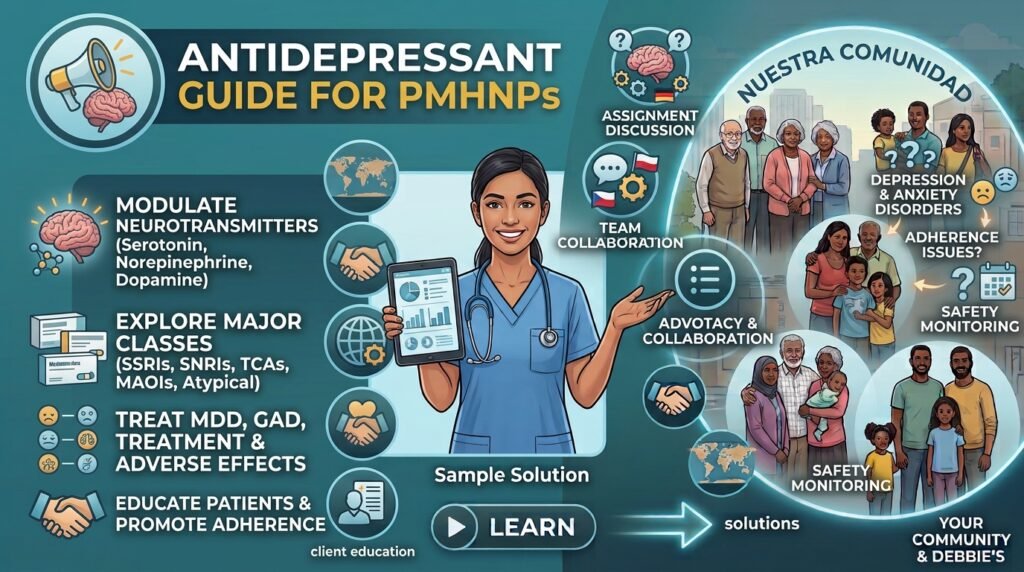
Topic: Antidepressants
Antidepressants are medications commonly used in the treatment of depression and several other mental health conditions. They help manage symptoms such as persistent sadness, loss of interest, low energy, anxiety, and changes in sleep or appetite. These medications are an important part of psychiatric mental health practice because they can improve emotional well-being, daily functioning, and overall quality of life.
Antidepressants work by influencing chemical signaling in the brain, particularly pathways involving neurotransmitters such as serotonin, norepinephrine, and dopamine. Different antidepressants affect these neurotransmitters in different ways, which influences their therapeutic effects, potential side effects, and clinical uses.
For psychiatric-mental health nurse practitioners (PMHNPs), understanding antidepressants is essential for selecting appropriate medications, evaluating treatment responses, monitoring adverse effects, and educating patients about safe medication use.
What Are Antidepressants?
Antidepressants are psychiatric medications primarily prescribed to treat depressive disorders. They influence neurotransmitter activity in the brain to help regulate mood, emotions, motivation, sleep, and other mental processes.
Although their primary use is treating depression, antidepressants are also prescribed for several other conditions, including:
- Generalized anxiety disorder (GAD).
- Panic disorder.
- Obsessive-compulsive disorder (OCD).
- Post-traumatic stress disorder (PTSD).
- Social anxiety disorder.
- Certain chronic pain conditions.
Antidepressants do not work in exactly the same way. Some increase the availability of serotonin, while others influence norepinephrine, dopamine, or multiple neurotransmitter systems.
They are not intended to produce immediate happiness or change a person’s personality. Instead, they help manage symptoms associated with mental health conditions and support improved functioning over time.
How Do Antidepressants Work?
Antidepressants primarily work by modifying neurotransmitter signaling in the central nervous system.
Neurotransmitters are chemical messengers that allow nerve cells, also called neurons, to communicate with one another. They are involved in regulating mood, attention, motivation, sleep, appetite, and emotional responses.
Three neurotransmitters commonly associated with antidepressant action include:
- Serotonin: Involved in mood regulation, sleep, appetite, and emotional processing.
- Norepinephrine: Plays a role in alertness, attention, energy, and stress responses.
- Dopamine: Involved in motivation, reward processing, pleasure, and movement.
Different antidepressant classes influence these neurotransmitter systems through different mechanisms.
For example:
- Selective serotonin reuptake inhibitors (SSRIs) reduce serotonin reuptake, increasing serotonin availability in the synaptic space.
- Serotonin-norepinephrine reuptake inhibitors (SNRIs) reduce the reuptake of both serotonin and norepinephrine.
- Tricyclic antidepressants (TCAs) also inhibit serotonin and norepinephrine reuptake but affect additional receptors.
- Monoamine oxidase inhibitors (MAOIs) block enzymes responsible for breaking down certain neurotransmitters.
- Some atypical antidepressants influence neurotransmitter activity through mechanisms that differ from these traditional classes.
Although these medications affect neurotransmitter signaling, depression is not explained by a simple chemical imbalance. It involves complex interactions among biological, psychological, genetic, and environmental factors.
What Are the Different Types of Antidepressants?
Antidepressants are classified into several groups according to their mechanisms of action and pharmacological properties. Understanding these classifications helps healthcare professionals recognize how different medications work and what considerations are involved in their use.
1. Selective Serotonin Reuptake Inhibitors (SSRIs)
SSRIs are commonly prescribed antidepressants and are frequently used as initial medication options for major depressive disorder and several anxiety disorders.
They work by blocking the serotonin transporter, which reduces the reuptake of serotonin into the presynaptic neuron. This increases serotonin availability in the synaptic space.
Common examples include:
- Fluoxetine (Prozac).
- Sertraline (Zoloft).
- Escitalopram (Lexapro).
- Citalopram (Celexa).
- Paroxetine (Paxil).
- Fluvoxamine (Luvox).
SSRIs are generally better tolerated than older antidepressant classes, although they can still cause adverse effects such as nausea, headache, sleep disturbances, and sexual dysfunction.
2. Serotonin-Norepinephrine Reuptake Inhibitors (SNRIs)
SNRIs influence two important neurotransmitters: serotonin and norepinephrine.
They work by inhibiting the reuptake of both neurotransmitters, increasing their availability for signaling between neurons.
Common examples include:
- Venlafaxine (Effexor XR).
- Duloxetine (Cymbalta).
- Desvenlafaxine (Pristiq).
- Levomilnacipran (Fetzima).
SNRIs are used to treat depression and certain anxiety disorders. Some, including duloxetine and venlafaxine, are also used for selected chronic pain conditions.
Potential adverse effects include nausea, sweating, insomnia, sexual dysfunction, and increased blood pressure with some medications.
3. Tricyclic Antidepressants (TCAs)
TCAs are an older class of antidepressants that affect serotonin and norepinephrine reuptake. However, they also interact with other receptors, including histamine, muscarinic cholinergic, and alpha-1 adrenergic receptors.
Examples include:
- Amitriptyline.
- Nortriptyline.
- Imipramine.
- Clomipramine.
- Desipramine.
TCAs may be used for depression and selected other conditions, including certain chronic pain syndromes and OCD (particularly clomipramine).
Their additional receptor effects contribute to adverse reactions such as dry mouth, constipation, blurred vision, urinary retention, sedation, and orthostatic hypotension. Overdose can cause serious cardiac and neurological complications.
4. Monoamine Oxidase Inhibitors (MAOIs)
MAOIs are antidepressants that work by inhibiting monoamine oxidase enzymes. These enzymes normally break down neurotransmitters such as serotonin, norepinephrine, and dopamine.
By inhibiting these enzymes, MAOIs increase the availability of these neurotransmitters in the brain.
Examples include:
- Phenelzine (Nardil).
- Tranylcypromine (Parnate).
- Isocarboxazid (Marplan).
- Selegiline transdermal system (Emsam).
MAOIs may be prescribed for depression when other treatment approaches have not been effective or when a particular clinical situation supports their use.
They require careful medication and dietary precautions because of potentially serious interactions. For example, consuming foods high in tyramine while taking certain MAOIs can cause a dangerous increase in blood pressure. Interactions with other medications can also lead to serious complications, including serotonin syndrome.
5. Atypical Antidepressants
Atypical antidepressants are medications that do not fit neatly into the traditional SSRI, SNRI, TCA, or MAOI classifications. They work through different mechanisms involving neurotransmitter receptors, transporters, or other signaling pathways.
Examples include:
- Bupropion (Wellbutrin): Primarily affects norepinephrine and dopamine signaling. It is used for depression and smoking cessation.
- Mirtazapine (Remeron): Influences norepinephrine and serotonin signaling through receptor blockade. It may cause sedation and increased appetite.
- Trazodone (Desyrel): Acts on serotonin receptors and inhibits serotonin reuptake. It is used for depression and is also prescribed off-label for insomnia.
- Vilazodone (Viibryd): Inhibits serotonin reuptake and acts as a partial agonist at certain serotonin receptors.
- Vortioxetine (Trintellix): Modulates several serotonin receptors and inhibits serotonin reuptake.
The adverse effects and therapeutic uses of atypical antidepressants vary depending on the specific medication.
What Conditions Are Antidepressants Used to Treat?
Although antidepressants are primarily associated with depression treatment, they have several other clinical applications.
1. Major Depressive Disorder (MDD)
Antidepressants are commonly prescribed to reduce symptoms such as persistent sadness, loss of interest, fatigue, feelings of worthlessness, and difficulty concentrating.
2. Generalized Anxiety Disorder (GAD)
Certain antidepressants, particularly SSRIs and SNRIs, are used to manage excessive and persistent worry, restlessness, and other anxiety symptoms.
3. Panic Disorder
SSRIs and some SNRIs may help reduce recurrent panic attacks and associated anticipatory anxiety.
4. Obsessive-Compulsive Disorder (OCD)
Certain SSRIs and clomipramine are used to reduce intrusive thoughts and repetitive behaviors associated with OCD.
5. Post-Traumatic Stress Disorder (PTSD)
Selected antidepressants, including sertraline and paroxetine, are used to manage PTSD symptoms in appropriate patients.
6. Chronic Pain Conditions
Some antidepressants, particularly duloxetine and certain TCAs, are used to manage selected chronic pain conditions, including neuropathic pain and fibromyalgia.
The choice of antidepressant depends on the condition being treated, symptom presentation, medical history, previous treatment response, and potential adverse effects.
How Long Do Antidepressants Take to Work?
Antidepressants do not usually produce their full therapeutic effects immediately. Although some individuals may notice early changes in sleep, appetite, or energy, improvement in depressive symptoms commonly develops over several weeks.
The response varies depending on the medication, dosage, individual biology, diagnosis, and other clinical factors.
Several factors influence how quickly a person responds:
- The type of antidepressant prescribed.
- The prescribed dosage and treatment duration.
- Individual differences in medication metabolism.
- The severity and characteristics of symptoms.
- Consistency in taking the medication.
- Other medical or psychological conditions.
Regular follow-up appointments help healthcare professionals determine whether the medication is effective and whether any treatment adjustments are needed.
What Are the Common Side Effects of Antidepressants?
Like other medications, antidepressants can cause side effects. These vary according to the medication class, dosage, and individual response.
Common adverse effects include:
- Nausea and gastrointestinal discomfort.
- Headaches.
- Dizziness.
- Changes in sleep patterns.
- Increased sweating.
- Sexual dysfunction.
- Changes in appetite or weight.
- Dry mouth.
- Fatigue or drowsiness.
Some antidepressants also have specific safety concerns. For example, SSRIs and SNRIs can increase bleeding risk, particularly when combined with certain medications such as anticoagulants or nonsteroidal anti-inflammatory drugs. SNRIs may increase blood pressure, while TCAs can cause cardiac conduction abnormalities, particularly in overdose.
Antidepressants can also increase the risk of serotonin syndrome when combined with other medications that significantly increase serotonin activity.
Additionally, antidepressants carry a warning about increased suicidal thoughts and behaviors in children, adolescents, and young adults, particularly during early treatment and dosage changes. Appropriate monitoring is important for these groups.
Patients should report concerning or severe adverse effects to their healthcare provider rather than independently stopping or changing their medication.
Important Considerations in Antidepressant Treatment
Safe antidepressant treatment requires more than selecting a medication. Healthcare professionals must consider individual patient factors and evaluate treatment throughout its course.
Important considerations include:
1. Screening for bipolar disorder: Before starting antidepressant treatment, clinicians should assess for a history of mania or hypomania because antidepressant monotherapy may trigger mood switching in individuals with bipolar disorder.
2. Drug interactions: Some antidepressants interact with other psychiatric medications, pain medications, supplements, and other substances. These interactions may increase adverse effects or alter medication effectiveness.
3. Medication discontinuation: Stopping certain antidepressants abruptly can cause discontinuation symptoms, including dizziness, nausea, sleep disturbances, and flu-like symptoms. When appropriate, discontinuation should be planned with a healthcare professional.
4. Individual treatment response: Patients may respond differently to the same antidepressant. A medication that works well for one individual may be ineffective or poorly tolerated by another.
5. Ongoing monitoring: Follow-up assessments help evaluate symptom improvement, adherence, adverse effects, and potential safety concerns.
The Role of PMHNPs in Antidepressant Management
Psychiatric-mental health nurse practitioners play an important role in the assessment, prescribing, and monitoring of antidepressant treatment within their legal scope of practice.
Their responsibilities include:
- Assessing depressive and other psychiatric symptoms.
- Evaluating medical history and previous antidepressant use.
- Screening for bipolar disorder and relevant safety concerns.
- Selecting appropriate antidepressants based on clinical needs.
- Monitoring treatment response and adverse effects.
- Educating patients about medication use and possible interactions.
- Evaluating adherence and addressing treatment barriers.
- Adjusting treatment when clinically indicated.
- Coordinating care with other healthcare professionals when necessary.
PMHNPs should also recognize that antidepressants are not the only treatment option for depression. Depending on the patient’s needs, treatment may include psychotherapy, lifestyle interventions, social support, and other appropriate mental health services.
Key Takeaways
- Antidepressants are psychiatric medications primarily used to treat depression and several other mental health conditions.
- They work by modifying neurotransmitter signaling, particularly pathways involving serotonin, norepinephrine, and dopamine.
- Major antidepressant classes include SSRIs, SNRIs, TCAs, MAOIs, and atypical antidepressants.
- Different antidepressants have different therapeutic uses, mechanisms of action, and potential adverse effects.
- Antidepressants commonly take several weeks to produce their full therapeutic effects.
- Safe treatment requires appropriate medication selection, monitoring, patient education, and evaluation of individual responses.
- PMHNPs play an important role in managing antidepressant treatment and supporting patient safety.