
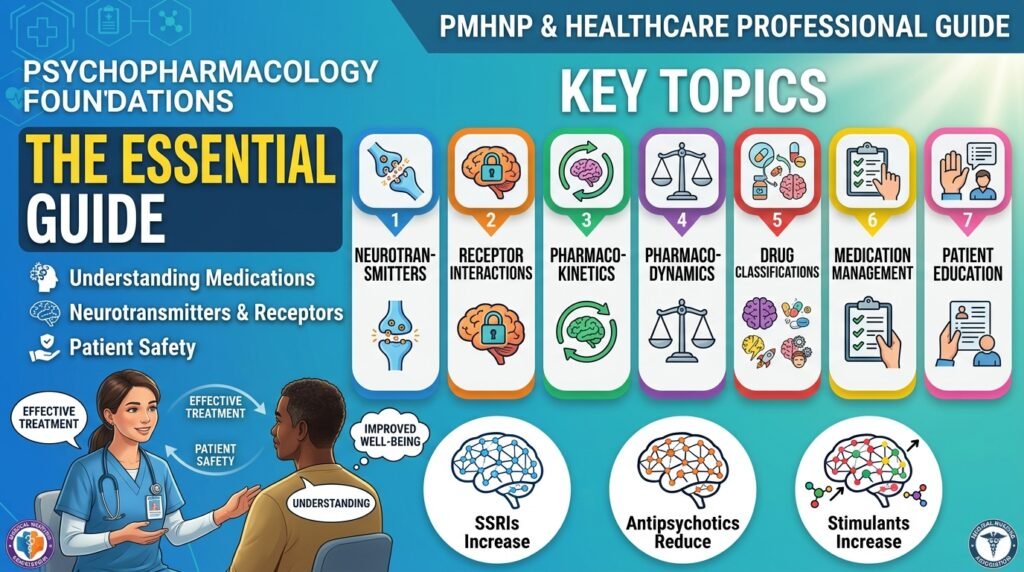
Psychopharmacology is a fundamental area of psychiatric mental health practice that focuses on how medications affect brain function, behavior, emotions, and mental health conditions. It helps healthcare professionals understand how psychiatric medications work, why they are prescribed, and how they influence symptoms associated with conditions such as depression, anxiety disorders, bipolar disorder, schizophrenia, and attention-deficit/hyperactivity disorder (ADHD).
For psychiatric-mental health nurse practitioners (PMHNPs), understanding the foundations of psychopharmacology is essential for making informed medication decisions, evaluating treatment outcomes, identifying adverse effects, and promoting patient safety.
This area of study covers several interconnected concepts, including neurotransmitters, medication classifications, pharmacokinetics, pharmacodynamics, and safe medication management. Understanding these foundations provides the knowledge needed to apply more advanced psychopharmacological principles in psychiatric care.
What Is Psychopharmacology?
Psychopharmacology is the study of how medications affect the brain, nervous system, mental processes, mood, and behavior. It examines how drugs interact with neurotransmitters, receptors, and other biological systems to produce therapeutic effects or adverse reactions.
In psychiatric mental health practice, psychopharmacology focuses primarily on medications used to manage mental health conditions. These medications influence brain signaling pathways involved in processes such as mood regulation, attention, motivation, sleep, perception, and emotional responses.
For example, antidepressants may influence serotonin and norepinephrine signaling, while antipsychotics commonly affect dopamine signaling. Mood stabilizers influence different biological pathways involved in regulating mood.
Psychopharmacology does not assume that mental health conditions result from a single chemical imbalance. Rather, it recognizes that psychiatric disorders involve complex interactions among biological, psychological, genetic, and environmental factors.
Why Is Psychopharmacology Important in Psychiatric Mental Health Nursing?
Knowledge of psychopharmacology helps psychiatric nursing professionals understand how medications contribute to the treatment of mental health conditions.
Its importance includes:
Supporting medication selection: Understanding medication mechanisms and classifications helps clinicians identify appropriate treatment options.
Promoting patient safety: Knowledge of adverse effects, contraindications, and drug interactions helps reduce medication-related risks.
Evaluating treatment effectiveness: Understanding therapeutic responses helps clinicians determine whether medications are achieving their intended outcomes.
Improving patient education: Nurses can explain medication purposes, expected effects, potential adverse reactions, and adherence considerations.
Supporting individualized care: Knowledge of medication responses and patient-specific factors helps guide treatment decisions.
Encouraging evidence-based practice: Psychopharmacology provides a scientific foundation for medication-related clinical decisions.
Essential Subtopics Under Foundations of Psychopharmacology
The foundations of psychopharmacology can be explored through eight interconnected topics. Each addresses an important aspect of understanding psychiatric medications and their application in mental health practice.
1. What Is Psychopharmacology? A Guide to Psychiatric Medications
Introduces psychopharmacology, its meaning, scope, and importance in psychiatric mental health care.
Explores how psychiatric medications influence brain activity and mental health symptoms.
2. How Do Psychiatric Medications Work? Understanding Neurotransmitters
Explains how psychiatric medications affect communication between nerve cells.
Covers neurotransmitter release, reuptake inhibition, receptor activation, and receptor blockade.
3. Pharmacokinetics and Pharmacodynamics in Psychopharmacology
Explores how the body processes psychiatric medications and how medications produce their effects.
Covers absorption, distribution, metabolism, excretion, drug-receptor interactions, and dose-response relationships.
4. Serotonin, Dopamine, and Norepinephrine: Their Role in Mental Health
Examines three important neurotransmitters involved in mood, motivation, attention, and other mental processes.
Explains how changes in their signaling relate to psychiatric symptoms and medication mechanisms.
5. How Are Psychiatric Medications Classified? Types of Psychotropic Drugs
Introduces the major classes of psychiatric medications.
Covers antidepressants, antipsychotics, mood stabilizers, anxiolytics, sedatives, stimulants, and non-stimulant ADHD medications.
6. What Is Medication Management in Psychiatric Mental Health Practice?
Explains the process of assessing, prescribing, monitoring, and adjusting psychiatric medications.
Explores treatment evaluation, medication safety, patient education, and the role of PMHNPs.
The Role of PMHNPs in Applying Psychopharmacology Principles
Psychiatric-mental health nurse practitioners use psychopharmacology knowledge to support the assessment and treatment of individuals experiencing mental health conditions.
Their responsibilities may include:
Assessing psychiatric symptoms and determining whether medication treatment may be appropriate.
Selecting medications based on clinical presentation, medical history, previous treatment responses, and individual patient needs.
Understanding medication mechanisms to anticipate therapeutic effects and possible adverse reactions.
Monitoring medication effectiveness and identifying potential safety concerns.
Educating patients about medication use, expected outcomes, and possible adverse effects.
Evaluating treatment progress and making medication adjustments within their legal scope of practice.
Collaborating with other healthcare professionals to support coordinated psychiatric care.
Applying these principles requires ongoing clinical judgment, awareness of current evidence, and consideration of each patient’s circumstances.
Note!!
Psychopharmacology examines how medications influence brain activity, mood, behavior, and mental health.
Understanding neurotransmitters, pharmacokinetics, and pharmacodynamics provides the scientific foundation for psychiatric medication practice.
Psychiatric medications are classified into different groups according to their therapeutic uses and mechanisms of action.
Individual factors such as genetics, age, medical history, and drug interactions can influence medication response.
Safe psychotropic medication use requires appropriate assessment, monitoring, patient education, and treatment evaluation.
PMHNPs apply psychopharmacology principles to support effective, individualized, and safe psychiatric care.