
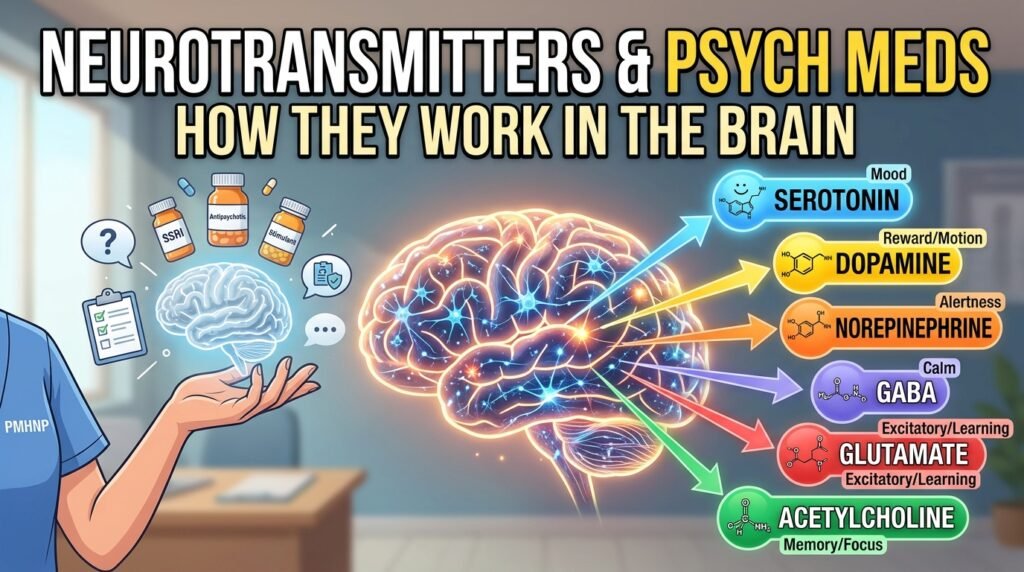
Psychiatric medications play an important role in managing mental health conditions by influencing chemical communication within the brain. These medications are used to treat conditions such as depression, anxiety disorders, bipolar disorder, schizophrenia, and attention-deficit/hyperactivity disorder (ADHD).
To understand how psychiatric medications work, it is important to understand neurotransmitters and their role in brain function. Neurotransmitters are chemical messengers that allow nerve cells to communicate with one another. Many psychiatric medications influence how these chemicals are produced, released, transported, or received by brain cells.
For Psychiatric-Mental Health Nurse Practitioners (PMHNPs), understanding neurotransmitters helps explain medication mechanisms, expected therapeutic effects, and potential adverse reactions.
What Are Neurotransmitters?
Neurotransmitters are chemical substances that transmit signals between nerve cells, also known as neurons. They allow different parts of the nervous system to communicate and help regulate important functions such as mood, memory, sleep, attention, motivation, and behavior.
Neurons communicate through specialized structures called synapses. When an electrical signal reaches the end of a neuron, neurotransmitters are released into the synaptic space. They then bind to specific receptors on another neuron, producing a response.
After transmitting a signal, neurotransmitters may be taken back into the releasing neuron through a process called reuptake, broken down by enzymes, or removed from the synaptic space through other mechanisms.
Psychiatric medications can influence different stages of this communication process, changing how signals are transmitted between neurons.
How Do Psychiatric Medications Work in the Brain?
Psychiatric medications work by modifying neurotransmitter activity and receptor signaling. Depending on the medication, they may increase, decrease, or otherwise regulate the effects of certain chemical messengers.
Some common mechanisms include:
1. Blocking neurotransmitter reuptake
Some medications prevent neurotransmitters from being transported back into the neuron that released them. This increases their availability in the synaptic space.
For example, selective serotonin reuptake inhibitors (SSRIs) block serotonin reuptake, increasing serotonin signaling. This is one of the main mechanisms through which these antidepressants work.
2. Blocking neurotransmitter receptors
Some psychiatric medications attach to receptors and prevent neurotransmitters from activating them.
For example, many antipsychotic medications block dopamine D2 receptors, reducing dopamine signaling in certain brain pathways.
3. Stimulating neurotransmitter receptors
Certain medications activate specific receptors, producing effects similar to those of naturally occurring neurotransmitters.
For example, buspirone acts as a partial agonist at serotonin 5-HT1A receptors and is used in the treatment of anxiety disorders.
4. Enhancing neurotransmitter activity
Some medications increase the effects of particular neurotransmitters without necessarily increasing their concentration.
For example, benzodiazepines enhance the activity of gamma-aminobutyric acid (GABA) at GABA-A receptors, producing calming and sedative effects.
5. Influencing neurotransmitter release
Some medications affect how much of a neurotransmitter is released into the synaptic space.
For example, stimulant medications used to treat ADHD increase dopamine and norepinephrine signaling through effects on neurotransmitter transport and release.
Major Neurotransmitters Involved in Mental Health
Several neurotransmitters are particularly important in psychopharmacology because they influence brain functions associated with mental health conditions.
1. Serotonin
Serotonin is involved in regulating mood, sleep, appetite, emotional processing, and other body functions.
Changes in serotonin signaling are associated with several psychiatric conditions, including depression and anxiety disorders.
How medications affect serotonin:
SSRIs, such as fluoxetine, sertraline, and escitalopram, inhibit serotonin reuptake. This increases serotonin availability in the synaptic space and changes serotonin signaling.
SNRIs, such as venlafaxine and duloxetine, also increase serotonin signaling while affecting norepinephrine reuptake.
2. Dopamine
Dopamine plays an important role in motivation, reward, pleasure, movement, attention, and learning. Different dopamine pathways are involved in different brain functions.
Abnormal dopamine signaling is associated with conditions such as schizophrenia and is also relevant to ADHD and other psychiatric disorders.
How medications affect dopamine:
Many antipsychotic medications block dopamine D2 receptors, reducing dopamine signaling in particular pathways. This helps manage positive symptoms of schizophrenia, such as hallucinations and delusions.
Stimulant medications used for ADHD increase dopamine signaling, helping improve attention and impulse control.
3. Norepinephrine
Norepinephrine, also known as noradrenaline, is involved in alertness, attention, energy, and the body’s response to stress.
Its signaling is relevant to depression, anxiety, and attention-related conditions.
How medications affect norepinephrine:
SNRIs, such as venlafaxine and duloxetine, inhibit the reuptake of norepinephrine and serotonin.
Certain ADHD medications, including atomoxetine, selectively inhibit norepinephrine reuptake, helping improve attention and reduce impulsivity.
4. Gamma-Aminobutyric Acid (GABA)
GABA is the main inhibitory neurotransmitter in the brain. It reduces neuronal excitability and helps regulate anxiety, relaxation, and sleep.
Reduced inhibitory signaling may contribute to increased nervous system activity.
How medications affect GABA:
Benzodiazepines, such as lorazepam and clonazepam, enhance the effects of GABA at GABA-A receptors. This produces calming, muscle-relaxing, anticonvulsant, and sedative effects.
5. Glutamate
Glutamate is the primary excitatory neurotransmitter in the central nervous system. It plays an important role in learning, memory, and communication between neurons.
Changes in glutamate signaling have been studied in several psychiatric conditions, including depression and schizophrenia.
How medications affect glutamate:
Ketamine affects glutamate signaling by blocking NMDA receptors. At carefully controlled subanesthetic doses, it can produce rapid antidepressant effects in some patients with treatment-resistant depression.
Esketamine, a related medication, is also used for specific treatment-resistant depression indications under controlled clinical supervision.
6. Acetylcholine
Acetylcholine is involved in memory, attention, learning, and muscle activity. It plays an important role in communication within the central and peripheral nervous systems.
How medications affect acetylcholine:
Some psychiatric medications block muscarinic acetylcholine receptors, producing anticholinergic effects such as dry mouth, constipation, blurred vision, and difficulty urinating.
For example, certain antipsychotics and tricyclic antidepressants have anticholinergic properties.
Relationship Between Neurotransmitters and Psychiatric Medication Classes
Different psychiatric medication classes target different neurotransmitter systems. The following examples illustrate these relationships.
- Antidepressants: SSRIs increase serotonin signaling, while SNRIs increase serotonin and norepinephrine signaling.
- Antipsychotics: Many reduce dopamine signaling through dopamine D2 receptor blockade.
- Benzodiazepines: Enhance GABA activity, reducing excessive neuronal excitability.
- ADHD stimulants: Increase dopamine and norepinephrine signaling, improving attention and impulse control.
- Buspirone: Acts on serotonin 5-HT1A receptors and is used to manage anxiety.
- Ketamine: Influences glutamate signaling through NMDA receptor blockade and is used in specific treatment-resistant depression settings.
Why Do Psychiatric Medications Take Time to Work?
Not all psychiatric medications produce their full therapeutic effects immediately. Some medications begin influencing neurotransmitter activity soon after administration, but noticeable improvements in symptoms may take longer.
For example, SSRIs begin affecting serotonin reuptake relatively early, but their full antidepressant benefits commonly take several weeks to develop.
This delay is partly associated with gradual changes in receptor sensitivity, intracellular signaling, and neural network functioning. The exact mechanisms are complex and may differ between medications and individuals.
Other medications, such as benzodiazepines, can produce noticeable effects much more quickly. Ketamine-based treatments may also produce relatively rapid antidepressant effects in selected patients.
The time required for improvement depends on the medication, the condition being treated, dosage, and individual response.
Importance of Understanding Neurotransmitters in Psychiatric Nursing
Understanding neurotransmitters helps psychiatric nurses connect medication mechanisms with clinical symptoms and treatment outcomes.
This knowledge is important because it helps healthcare professionals:
- Understand medication mechanisms: Recognize how different psychiatric drugs influence neurotransmitter systems.
- Select appropriate treatments: Understand why certain medication classes are used for particular mental health conditions.
- Monitor therapeutic responses: Evaluate whether patients are experiencing improvements in mood, sleep, attention, or other symptoms.
- Recognize adverse effects: Identify unwanted effects associated with medications that influence particular neurotransmitter systems.
- Educate patients: Explain how psychiatric medications work and why some treatments take time to produce noticeable benefits.
- Promote medication safety: Recognize potential risks associated with drug interactions and excessive neurotransmitter activity.
Role of Psychiatric-Mental Health Nurse Practitioners
Psychiatric-Mental Health Nurse Practitioners use knowledge of neurotransmitters to support evidence-based medication management and individualized psychiatric care.
Their responsibilities include:
- Assessing psychiatric symptoms: Evaluating changes in mood, thought processes, behavior, sleep, attention, and functioning.
- Understanding medication mechanisms: Considering how prescribed medications affect neurotransmitter activity and how these effects relate to treatment goals.
- Monitoring treatment outcomes: Assessing whether medications are improving symptoms and identifying concerns that may require further evaluation.
- Identifying adverse reactions: Monitoring for medication-related effects such as excessive sedation, movement disorders, or symptoms of serotonin syndrome.
- Educating patients: Explaining medication purposes, expected treatment timelines, and possible side effects.
- Adjusting treatment when appropriate: Reviewing medication effectiveness and tolerability before making clinically appropriate changes within their scope of practice.
Note!
- Neurotransmitters are chemical messengers that allow nerve cells to communicate.
- Psychiatric medications influence neurotransmitter activity through mechanisms such as blocking reuptake, stimulating receptors, blocking receptors, and enhancing neurotransmitter effects.
- Major neurotransmitters involved in psychopharmacology include serotonin, dopamine, norepinephrine, GABA, glutamate, and acetylcholine.
- Different psychiatric medication classes target different neurotransmitter systems.
- Some psychiatric medications produce effects quickly, while others require several weeks for noticeable therapeutic improvement.
- Understanding neurotransmitters helps PMHNPs evaluate medication mechanisms, monitor treatment responses, identify adverse effects, and provide patient education.