
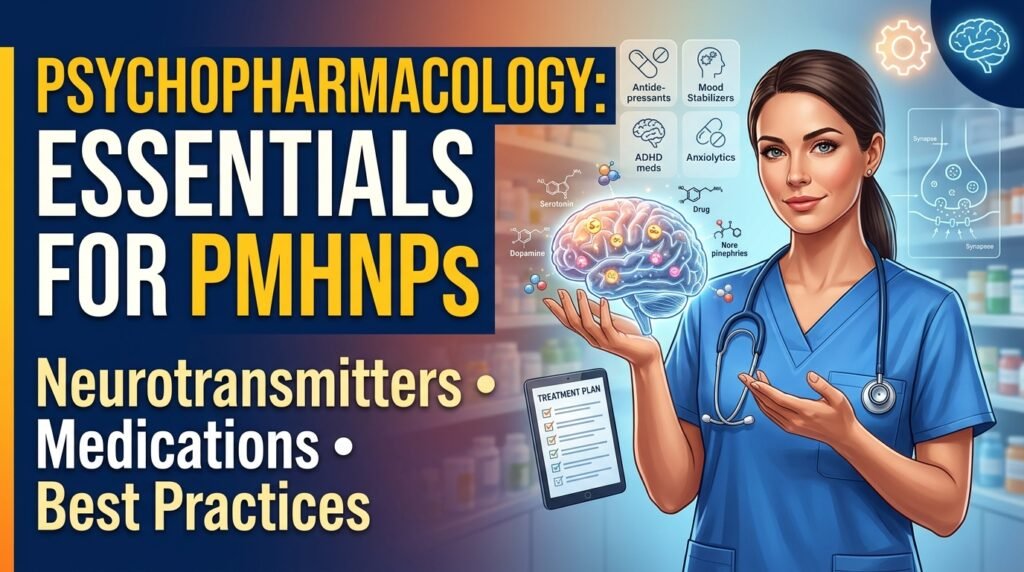
Psychopharmacology is an important area of psychiatric mental health practice that focuses on how medications affect the brain, behavior, mood, and mental processes. Psychiatric medications are commonly used to manage mental health conditions such as depression, anxiety disorders, bipolar disorder, schizophrenia, and attention-deficit/hyperactivity disorder (ADHD).
For Psychiatric-Mental Health Nurse Practitioners (PMHNPs), understanding psychopharmacology is essential for making informed medication decisions, monitoring treatment outcomes, identifying adverse effects, and supporting patients throughout treatment. This knowledge helps healthcare professionals use psychiatric medications safely and effectively while considering each patient’s individual needs.
What Is Psychopharmacology?
Psychopharmacology is the study of how medications influence brain activity, behavior, emotions, and mental functioning. It examines how psychiatric drugs interact with the nervous system to affect neurotransmitters, which are chemical messengers responsible for communication between nerve cells.
In mental health care, psychopharmacology focuses on the use of medications to manage symptoms and improve functioning in individuals experiencing psychiatric conditions.
For example, antidepressants may help manage symptoms of depression by influencing neurotransmitters such as serotonin and norepinephrine. Antipsychotic medications may reduce hallucinations and delusions by affecting dopamine activity in the brain.
Psychopharmacology also involves understanding how medications are absorbed, distributed, metabolized, and eliminated from the body, as well as their therapeutic effects, side effects, and potential interactions.
How Do Psychiatric Medications Work?
Psychiatric medications work by influencing chemical communication within the brain and central nervous system. Different medications affect specific neurotransmitters or receptors involved in regulating mood, thinking, attention, sleep, and behavior.
Neurotransmitters are important because changes in their signaling pathways can contribute to symptoms associated with certain mental health conditions.
Some major neurotransmitters involved in psychopharmacology include:
- Serotonin: Helps regulate mood, sleep, appetite, and emotional responses. Many antidepressants, including selective serotonin reuptake inhibitors (SSRIs), increase serotonin signaling.
- Dopamine: Plays a role in motivation, reward, movement, and attention. Antipsychotic medications often work by blocking or modifying dopamine receptor activity.
- Norepinephrine: Influences alertness, attention, energy, and the body’s stress response. Some antidepressants increase norepinephrine activity.
- Gamma-aminobutyric acid (GABA): The main inhibitory neurotransmitter in the brain. Benzodiazepines enhance GABA’s effects, producing calming and sedative effects.
- Glutamate: The major excitatory neurotransmitter involved in learning, memory, and brain activity. Some psychiatric treatments influence glutamate signaling.
Psychiatric medications do not all work in the same way. Their effects depend on the medication class, the receptors or neurotransmitters involved, and the individual’s response to treatment.
Major Classes of Psychiatric Medications
Psychiatric medications are classified according to their primary therapeutic uses and mechanisms of action. Understanding these categories helps PMHNPs select appropriate treatments and monitor their effects.
1. Antidepressants
Antidepressants are medications primarily used to treat depression. They are also prescribed for several other conditions, including anxiety disorders, obsessive-compulsive disorder (OCD), and certain chronic pain conditions.
Common types include:
- Selective serotonin reuptake inhibitors (SSRIs): Examples include fluoxetine, sertraline, and escitalopram. They increase serotonin availability by reducing its reuptake into nerve cells.
- Serotonin-norepinephrine reuptake inhibitors (SNRIs): Examples include venlafaxine and duloxetine. They increase serotonin and norepinephrine signaling.
- Tricyclic antidepressants (TCAs): Examples include amitriptyline and nortriptyline. They affect serotonin and norepinephrine reuptake but may cause more anticholinergic and cardiovascular side effects.
- Monoamine oxidase inhibitors (MAOIs): Examples include phenelzine and tranylcypromine. They inhibit the enzyme responsible for breaking down certain neurotransmitters.
- Atypical antidepressants: This group includes medications such as bupropion and mirtazapine, which work through different mechanisms.
2. Antipsychotic Medications
Antipsychotics are used to manage symptoms associated with conditions such as schizophrenia, bipolar disorder, and certain psychotic disorders.
They are commonly divided into two main groups:
- First-generation antipsychotics: Also called typical antipsychotics, these medications primarily block dopamine D2 receptors. Examples include haloperidol and chlorpromazine.
- Second-generation antipsychotics: Also called atypical antipsychotics, these medications generally affect dopamine and serotonin receptor activity. Examples include risperidone, quetiapine, and olanzapine.
Antipsychotics can help reduce symptoms such as hallucinations, delusions, and disorganized thinking. However, they require monitoring for potential adverse effects, including movement disorders and metabolic changes.
3. Mood Stabilizers
Mood stabilizers are medications used primarily to manage mood episodes associated with bipolar disorder. They help reduce mood fluctuations and may be used to manage or prevent manic and depressive episodes.
Common examples include:
- Lithium: Used to treat acute mania and support long-term mood stabilization.
- Valproate: An anticonvulsant medication commonly used to manage manic episodes.
- Lamotrigine: Used mainly for maintenance treatment and prevention of depressive episodes in bipolar disorder.
- Carbamazepine: An anticonvulsant that may be used in managing manic or mixed episodes.
Patients taking mood stabilizers may require laboratory testing and clinical monitoring to assess medication levels, organ function, and potential adverse effects.
4. Anxiolytics
Anxiolytics are medications used to reduce symptoms of anxiety. They may help manage excessive worry, restlessness, tension, and other anxiety-related symptoms.
Examples include:
- Benzodiazepines: Such as lorazepam and clonazepam, which enhance GABA activity to produce calming effects.
- Buspirone: A medication used for anxiety that acts primarily through serotonin receptors.
- Hydroxyzine: An antihistamine that may be prescribed for short-term relief of anxiety symptoms.
Some anxiolytics, particularly benzodiazepines, carry risks of sedation, tolerance, dependence, and withdrawal. Their use requires careful clinical assessment.
5. Stimulants and Non-Stimulant ADHD Medications
These medications are used to manage attention-deficit/hyperactivity disorder (ADHD). They help improve attention, impulse control, and activity regulation.
Examples include:
- Stimulants: Methylphenidate and amphetamine-based medications increase dopamine and norepinephrine signaling.
- Non-stimulants: Atomoxetine, guanfacine, and clonidine are alternatives that work through different mechanisms.
Medication selection depends on the patient’s symptoms, age, medical history, treatment response, and potential adverse effects.
Important Concepts in Psychopharmacology
Understanding psychiatric medications requires knowledge of several pharmacological concepts that explain how drugs behave in the body.
Pharmacokinetics: This describes how the body processes a medication through absorption, distribution, metabolism, and excretion. It helps explain how long a medication takes to reach effective levels and how frequently it may need to be administered.
Pharmacodynamics: This refers to how a medication affects the body, including its interaction with receptors and its resulting therapeutic or adverse effects.
Half-life: The half-life is the time required for the concentration of a medication in the body to decrease by approximately half. It influences dosing intervals and how long a medication remains in the body.
Therapeutic effects: These are the intended benefits of a medication, such as reduced anxiety, improved mood, or fewer psychotic symptoms.
Adverse effects: These are unwanted effects that may occur during treatment. Examples include nausea, dizziness, sedation, weight gain, and movement abnormalities, depending on the medication.
Importance of Psychopharmacology in Psychiatric Mental Health Nursing
Psychopharmacology is essential in psychiatric nursing because medication treatment requires careful assessment, patient education, and ongoing evaluation.
Its importance includes:
- Supporting appropriate medication selection: Understanding medication classes and mechanisms helps healthcare professionals identify suitable treatment options based on the patient’s condition.
- Promoting medication safety: Knowledge of contraindications, adverse effects, and drug interactions helps reduce medication-related risks.
- Improving treatment outcomes: Monitoring symptoms and treatment responses helps determine whether medications are effective.
- Supporting patient education: Nurses explain medication purposes, administration instructions, expected benefits, and possible side effects.
- Encouraging medication adherence: Addressing patient concerns and explaining treatment expectations can improve adherence.
- Identifying complications early: Recognizing serious adverse reactions allows healthcare professionals to initiate timely assessment and intervention.
Role of Psychiatric-Mental Health Nurse Practitioners in Psychopharmacology
Psychiatric-Mental Health Nurse Practitioners play an important role in the safe and effective use of psychiatric medications. Their responsibilities involve assessing patients, developing treatment plans, monitoring medication responses, and providing ongoing support.
Key responsibilities include:
- Conducting psychiatric assessments: Evaluating symptoms, medical history, mental health history, current medications, and other factors that may influence treatment.
- Selecting and prescribing medications: Within their legal scope of practice, choosing appropriate psychiatric medications based on clinical findings and evidence-based guidelines.
- Monitoring treatment effectiveness: Evaluating changes in symptoms, functioning, and overall mental health.
- Identifying adverse effects: Assessing patients for medication-related complications and taking appropriate action when concerns arise.
- Educating patients and families: Explaining medication use, potential side effects, safety precautions, and the importance of following the prescribed treatment plan.
- Reviewing drug interactions: Considering how prescribed medications, over-the-counter products, and supplements may interact.
- Promoting individualized care: Considering patient preferences, medical conditions, treatment history, and personal circumstances when making medication decisions.
Note!
- Psychopharmacology is the study of how medications affect brain activity, mood, behavior, and mental functioning.
- Psychiatric medications work by influencing neurotransmitters and receptors involved in brain communication.
- Major medication classes include antidepressants, antipsychotics, mood stabilizers, anxiolytics, and ADHD medications.
- Pharmacokinetics explains how the body processes medications, while pharmacodynamics explains how medications affect the body.
- Understanding therapeutic effects, adverse effects, and drug interactions is essential for safe psychiatric medication management.
- PMHNPs use psychopharmacological knowledge to assess patients, select appropriate medications, monitor treatment, and support patient education.