
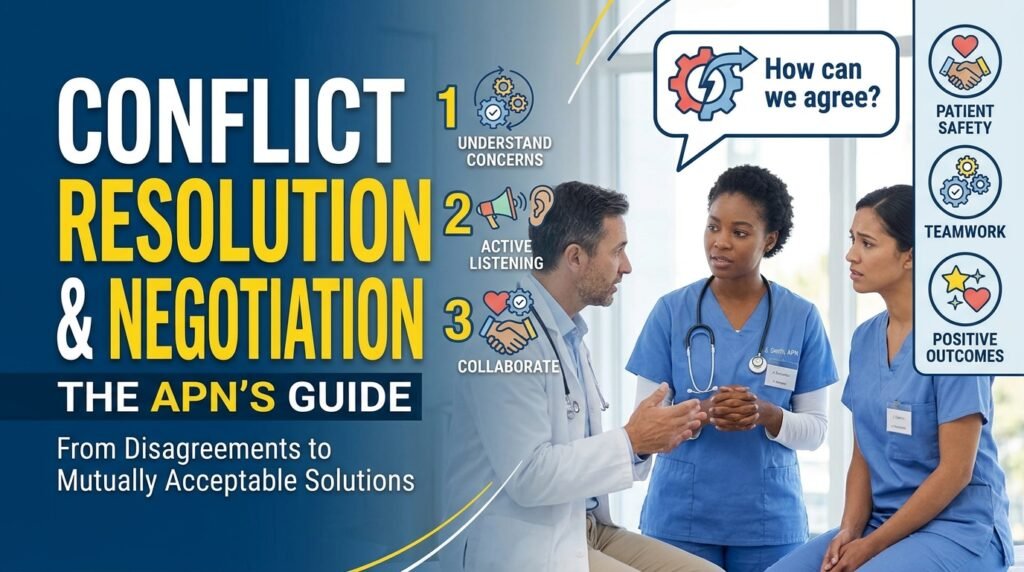
Healthcare teams bring together professionals with different responsibilities, experiences, knowledge, and perspectives. Although collaboration is essential for delivering quality patient care, disagreements can arise when team members have different opinions about treatment decisions, workload distribution, communication, or professional responsibilities.
When conflicts are not addressed appropriately, they can affect teamwork, staff relationships, and patient safety. Conflict resolution and negotiation are therefore important skills in healthcare, particularly for advanced practice nurses who often coordinate care and work with different professionals.
What Is Conflict Resolution in Healthcare Teams?
Conflict resolution refers to the process of identifying, addressing, and managing disagreements between individuals or groups to reach an acceptable solution.
In healthcare, conflicts may occur between nurses, physicians, pharmacists, therapists, administrators, and other healthcare professionals. These disagreements may involve clinical decisions, differences in professional opinions, communication problems, or limited healthcare resources.
Effective conflict resolution focuses on understanding the causes of disagreements, encouraging respectful communication, and finding solutions that support teamwork and patient-centered care.
What Is Negotiation in Healthcare?
Negotiation is a communication process in which two or more individuals discuss their differences and work toward an agreement that addresses their needs and concerns.
In healthcare teams, negotiation helps professionals find common ground when they have different opinions or priorities.
For example, a nurse may disagree with a physician about the timing of a patient’s discharge because the patient still requires additional monitoring. Through negotiation, both professionals can discuss the patient’s condition, review clinical information, and agree on an appropriate discharge plan.
While conflict resolution focuses on managing disagreements, negotiation is one of the approaches used to reach mutually acceptable solutions.
Common Causes of Conflict in Healthcare Teams
Conflicts can develop for several reasons, particularly in demanding healthcare environments where professionals must make important decisions under pressure.
- Poor communication: Incomplete handovers, unclear instructions, and misunderstandings can create disagreements among healthcare professionals.
- Differences in clinical opinions: Professionals may interpret patient information differently or recommend different treatment approaches.
- Unclear professional roles: Overlapping responsibilities or uncertainty about decision-making authority can lead to disagreements.
- Workload distribution: Unequal allocation of duties, staff shortages, and demanding schedules may cause frustration among team members.
- Limited resources: Competition for hospital beds, equipment, medications, and other resources can create tension.
- Professional hierarchy: Differences in authority and status may prevent junior staff from expressing concerns or challenging decisions.
- Personality and cultural differences: Different communication styles, values, and personal expectations may contribute to misunderstandings.
- Leadership challenges: Inconsistent leadership, poor supervision, and lack of accountability can create an environment where conflicts continue.
Types of Conflict in Healthcare Teams
Understanding the different types of conflict helps healthcare professionals identify the nature of disagreements and choose appropriate ways to address them.
Task conflict: Occurs when team members disagree about how a particular task should be completed or which approach should be used. For example, nurses and physicians may have different opinions about a patient’s care priorities.
Relationship conflict: Develops from personal disagreements, mistrust, personality differences, or negative interactions between colleagues.
Process conflict: Occurs when healthcare professionals disagree about how responsibilities should be assigned, how work should be organized, or who should complete particular tasks.
Value conflict: Arises when individuals have different beliefs, ethical principles, or professional values that influence their decisions and actions.
Conflict Resolution Strategies in Healthcare
Healthcare professionals can use different strategies to manage disagreements and maintain positive working relationships.
1. Open Communication
Encouraging honest and respectful communication allows team members to explain their concerns and understand different perspectives.
Professionals should listen carefully, avoid personal attacks, and focus discussions on the issue rather than blaming individuals.
2. Active Listening
Active listening involves giving full attention to another person’s concerns, asking relevant questions, and confirming understanding before responding.
This approach reduces misunderstandings and helps healthcare professionals identify the actual cause of a disagreement.
3. Collaboration
Collaboration involves working together to identify solutions that address the concerns of everyone involved while maintaining patient safety.
For example, nurses and physicians can review a patient’s clinical condition together and agree on the most appropriate treatment approach.
4. Mediation
Mediation involves using a neutral third party to help individuals resolve disagreements. A nurse manager, clinical supervisor, or other appropriate leader may facilitate discussions when team members cannot reach an agreement independently.
5. Compromise
Compromise occurs when individuals make adjustments to their original positions to reach an acceptable solution. It can be useful when both parties have valid concerns and an immediate agreement is necessary.
However, compromise should never involve ignoring clinical evidence or placing patient safety at risk.
6. Clear Role Definition
Clearly defining professional responsibilities helps prevent disagreements caused by overlapping duties or uncertainty about authority.
Healthcare leaders should ensure that team members understand their responsibilities and the appropriate channels for raising concerns.
The Negotiation Process in Healthcare Teams
Effective negotiation requires preparation, communication, and a willingness to consider different perspectives.
The process may involve the following steps:
1. Identify the disagreement: Clearly establish the issue causing conflict and identify the individuals or teams involved.
2. Understand each party’s concerns: Allow everyone involved to explain their position, priorities, and expectations without interruption or intimidation.
3. Gather relevant information: Review clinical records, healthcare guidelines, available resources, and other relevant information before discussing possible solutions.
4. Identify shared goals: Focus on common priorities, particularly patient safety, quality of care, and effective teamwork.
5. Discuss possible solutions: Explore different approaches and evaluate their advantages, limitations, and potential effects.
6. Reach an agreement: Select a solution that addresses the concerns raised while remaining consistent with professional responsibilities and patient safety requirements.
7. Implement and evaluate the agreement: Put the agreed solution into practice and review whether it has resolved the disagreement effectively.
Examples of Conflict Resolution and Negotiation in Nursing Practice
Conflict resolution and negotiation are used in different healthcare situations.
Disagreement about patient treatment: A nurse believes that a patient’s deteriorating condition requires immediate medical review, while another team member considers the condition stable. The nurse presents the patient’s vital signs and clinical observations, explains the safety concerns, and requests further assessment. The team reviews the available information and agrees on the appropriate intervention.
Workload distribution: Two nurses disagree about the allocation of patients because one believes the workload is uneven. The nurse manager listens to both professionals, reviews patient acuity and staffing needs, and adjusts the assignments fairly.
Communication breakdown during handover: An incoming nurse discovers that important patient information was not communicated during the previous shift. The nurses discuss the problem, identify what was missed, and agree to use a structured handover approach such as SBAR.
Disagreement over discharge planning: A nurse believes a patient requires further monitoring, while another healthcare professional recommends discharge. The team discusses the patient’s condition, recovery progress, and discharge requirements before agreeing on an appropriate plan.
Importance of Conflict Resolution and Negotiation in Healthcare
Effective conflict management contributes to a safer and more supportive healthcare environment.
- Promotes patient safety: Addressing disagreements allows healthcare professionals to identify potential risks and make appropriate clinical decisions.
- Strengthens teamwork: Respectful conflict management improves professional relationships and encourages cooperation.
- Improves communication: Team members become more comfortable discussing concerns and sharing different perspectives.
- Supports effective decision-making: Negotiation allows professionals to consider relevant information and reach well-informed agreements.
- Reduces workplace tension: Addressing disagreements early helps prevent frustration, mistrust, and prolonged workplace disputes.
- Improves staff satisfaction: A respectful environment where concerns are addressed can improve morale and professional relationships.
- Promotes continuity of care: Better coordination among healthcare professionals helps ensure that patient care plans are communicated and followed consistently.
Role of Advanced Practice Nurses in Conflict Resolution and Negotiation
Advanced practice nurses play an important role in managing disagreements because they often coordinate patient care, collaborate with multidisciplinary teams, and participate in clinical decision-making.
Their responsibilities include:
- Facilitating communication: Encouraging healthcare professionals to discuss concerns openly and respectfully.
- Promoting collaboration: Helping team members identify shared goals and work toward appropriate solutions.
- Advocating for patient safety: Raising concerns when disagreements or clinical decisions may place patients at risk.
- Supporting negotiation: Helping professionals consider different perspectives and reach reasonable agreements.
- Providing leadership: Addressing workplace disagreements, guiding discussions, and encouraging accountability.
- Maintaining professionalism: Demonstrating respect, emotional awareness, and fairness when managing difficult situations.
- Encouraging continuous improvement: Identifying recurring conflicts and recommending changes to communication, teamwork, or workplace procedures.
Advanced practice nurses should also recognize when a conflict requires formal reporting, management involvement, or escalation through established clinical and organizational procedures.
Note!
- Conflict resolution involves identifying and managing disagreements to reach acceptable solutions.
- Negotiation helps healthcare professionals discuss differences and work toward mutually acceptable agreements.
- Common causes of conflict include poor communication, differences in clinical opinions, unclear roles, workload pressures, and limited resources.
- Conflict may be task-related, relationship-based, process-related, or value-based.
- Strategies such as active listening, collaboration, mediation, compromise, and open communication help manage workplace disagreements.
- Advanced practice nurses promote effective conflict resolution through leadership, advocacy, communication, and teamwork.
- Patient safety and professional standards should remain priorities when resolving healthcare conflicts.