
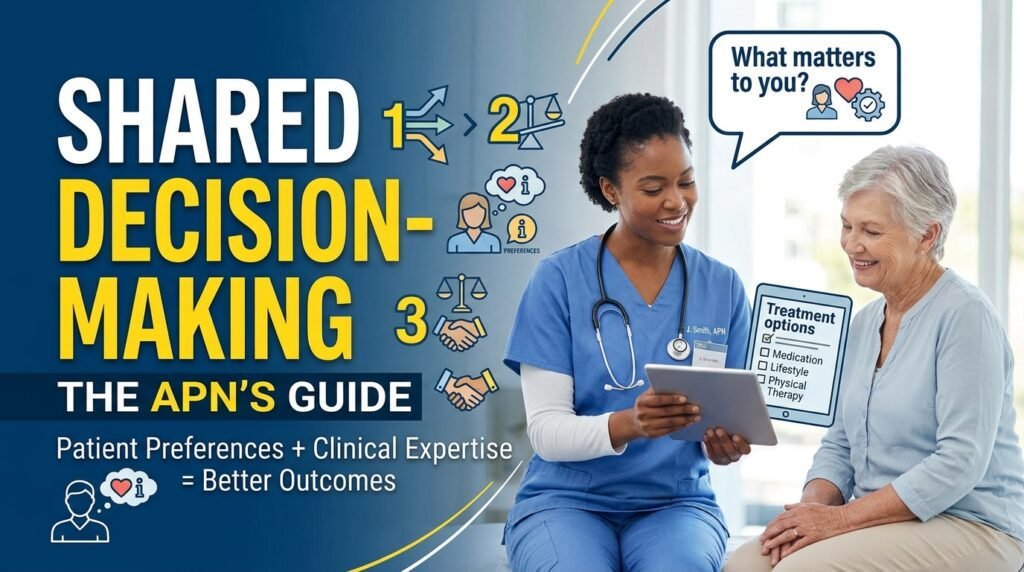
Healthcare decisions can significantly affect a patient’s health, quality of life, and treatment outcomes. Traditionally, healthcare professionals have often made treatment decisions based on their clinical knowledge and experience. However, modern healthcare recognizes that patients should also participate actively in decisions about their care.
Shared decision-making is an important part of advanced nursing practice because it encourages collaboration between healthcare professionals and patients. It ensures that clinical decisions consider not only medical evidence but also the patient’s preferences, values, needs, and personal circumstances.
What Is Shared Decision-Making in Advanced Nursing Practice?
Shared decision-making is a collaborative process in which healthcare professionals and patients work together to make informed decisions about treatment and healthcare options.
It involves sharing relevant medical information, discussing available choices, explaining potential benefits and risks, and considering what matters most to the patient.
In advanced nursing practice, advanced practice nurses (APNs) use their clinical expertise to guide patients through healthcare decisions while respecting their right to participate in choosing their preferred care options.
For example, a patient diagnosed with hypertension may have different treatment options, including medication, lifestyle changes, or a combination of both. An advanced practice nurse explains the available approaches, discusses their benefits and possible risks, and considers the patient’s preferences before agreeing on a treatment plan.
Importance of Shared Decision-Making in Healthcare
Shared decision-making promotes patient-centered care by ensuring that patients are actively involved in decisions that affect their health.
Its importance includes:
- Promotes patient autonomy: Patients have the opportunity to make informed choices about their healthcare rather than simply following instructions.
- Improves patient satisfaction: Patients are more likely to feel respected and valued when their opinions and preferences are considered.
- Supports informed decisions: Healthcare professionals explain available treatment options, including their potential benefits, risks, and limitations.
- Strengthens patient-provider relationships: Open discussions build trust and encourage patients to communicate their concerns.
- Improves treatment adherence: Patients may be more willing to follow treatment plans when they understand and have participated in developing them.
- Encourages individualized care: Treatment decisions can be adjusted to reflect a patient’s medical condition, lifestyle, cultural background, and personal goals.
- Reduces decisional conflict: Discussing available options helps patients understand their choices and feel more confident about the decisions they make.
Key Principles of Shared Decision-Making
Effective shared decision-making is guided by several principles that help healthcare professionals and patients work together.
1. Patient Autonomy
Patient autonomy refers to the right of individuals to make decisions about their own healthcare. Advanced practice nurses should respect patients’ choices, provided they have the necessary information and decision-making capacity.
2. Informed Choice
Patients should receive clear, accurate, and understandable information about their condition and available treatment options. This includes explaining possible benefits, risks, side effects, and alternative approaches.
3. Mutual Respect
Both the healthcare professional’s clinical expertise and the patient’s personal experiences and preferences should be valued. Nurses should avoid making patients feel pressured into accepting a particular treatment.
4. Effective Communication
Clear communication allows patients to ask questions, express concerns, and understand the information presented to them. Healthcare professionals should use language appropriate to the patient’s level of understanding.
5. Collaboration
Shared decision-making requires healthcare professionals and patients to work together to identify the most appropriate care options based on medical evidence and individual preferences.
Steps in the Shared Decision-Making Process
Advanced practice nurses can use a structured approach to guide patients through healthcare decisions.
1. Identify the need for a decision
The nurse explains that a healthcare decision needs to be made and identifies the condition or treatment issue that requires attention.
2. Discuss available options
The nurse presents the available treatment approaches, including appropriate alternatives. Patients should understand that different options may have different benefits and disadvantages.
3. Explain benefits and risks
Each option is discussed in terms of expected outcomes, possible complications, side effects, and other relevant considerations.
4. Explore patient preferences and values
The nurse encourages patients to express their concerns, expectations, beliefs, and personal priorities. For example, a patient may prefer a treatment that allows them to maintain their daily activities.
5. Make a decision together
The healthcare professional and patient discuss the available information and agree on a care approach that considers clinical evidence and the patient’s preferences.
6. Implement and review the decision
The agreed treatment plan is implemented and monitored. The nurse evaluates the patient’s response and discusses whether adjustments are necessary.
Examples of Shared Decision-Making in Advanced Nursing Practice
Shared decision-making can be applied in different healthcare settings and across various patient conditions.
Chronic disease management: An advanced practice nurse caring for a patient with type 2 diabetes discusses medication options, dietary changes, and physical activity. The patient shares concerns about medication side effects and work schedules, allowing the nurse to help develop a realistic management plan.
Cancer treatment: A nurse practitioner supporting a patient with cancer explains available treatment approaches, possible side effects, and expected outcomes. The patient’s preferences, treatment goals, and quality-of-life concerns are considered when discussing the next steps with the wider healthcare team.
Pain management: A patient experiencing chronic pain discusses different pain management options with an advanced practice nurse. Together, they consider medication, physical therapy, and other appropriate interventions based on the patient’s condition and preferences.
Maternal healthcare: A pregnant woman discusses available birth options with her healthcare provider. The provider explains potential benefits and risks while considering the woman’s health status, concerns, and preferences.
Barriers to Shared Decision-Making
Although shared decision-making has several benefits, certain challenges can limit its effective implementation.
- Limited health literacy: Some patients may struggle to understand complex medical information, treatment options, or potential risks.
- Language differences: Communication difficulties can prevent patients from fully understanding their healthcare choices.
- Time constraints: Heavy workloads and busy clinical environments may leave healthcare professionals with insufficient time for detailed discussions.
- Professional attitudes: Some healthcare providers may be accustomed to making decisions independently and may not encourage patient participation.
- Cultural beliefs: Patients’ cultural values and beliefs may influence how they view illness, treatment, and decision-making.
- Emotional distress: Fear, anxiety, or a serious diagnosis may make it difficult for patients to process information and evaluate their options.
- Limited treatment options: In some situations, clinical guidelines, resource availability, or the patient’s condition may restrict the available choices.
Strategies for Promoting Shared Decision-Making
Advanced practice nurses can strengthen patient participation through several practical approaches:
- Use simple language when explaining medical conditions and treatment options.
- Encourage patients to ask questions and express their concerns.
- Provide written information and decision aids when appropriate.
- Use qualified interpreters when language barriers affect communication.
- Allow patients sufficient time to consider important healthcare decisions.
- Respect cultural values, personal beliefs, and individual preferences.
- Involve family members or caregivers when the patient wishes and appropriate consent is provided.
- Revisit decisions when the patient’s condition, preferences, or treatment circumstances change.
Role of Advanced Practice Nurses in Shared Decision-Making
Advanced practice nurses play an important role in promoting shared decision-making because they combine advanced clinical knowledge with patient education, advocacy, and care coordination.
Their responsibilities include:
- Educating patients: Explaining diagnoses, treatment options, potential risks, and expected outcomes in understandable language.
- Supporting patient autonomy: Respecting patients’ rights to accept or refuse recommended treatments.
- Providing clinical guidance: Using evidence-based knowledge to help patients understand the suitability of different treatment options.
- Encouraging participation: Creating an environment where patients feel comfortable asking questions and expressing their preferences.
- Advocating for patients: Ensuring that patients’ needs, values, and concerns are considered during healthcare discussions.
- Coordinating care: Collaborating with other healthcare professionals to ensure that agreed treatment decisions are communicated and implemented.
- Evaluating outcomes: Monitoring treatment responses and discussing adjustments when necessary.
Through these responsibilities, advanced practice nurses help patients become active participants in their healthcare while ensuring that decisions remain clinically appropriate and evidence-based.
Note!
- Shared decision-making is a collaborative process in which healthcare professionals and patients make informed healthcare decisions together.
- It combines clinical evidence and professional expertise with patient preferences, values, and individual circumstances.
- Its key principles include patient autonomy, informed choice, mutual respect, effective communication, and collaboration.
- The process involves identifying decisions, discussing options, explaining risks and benefits, considering patient preferences, and reviewing outcomes.
- Barriers include limited health literacy, language differences, time constraints, cultural beliefs, and emotional distress.
- Advanced practice nurses promote shared decision-making through patient education, advocacy, communication, and clinical guidance.