
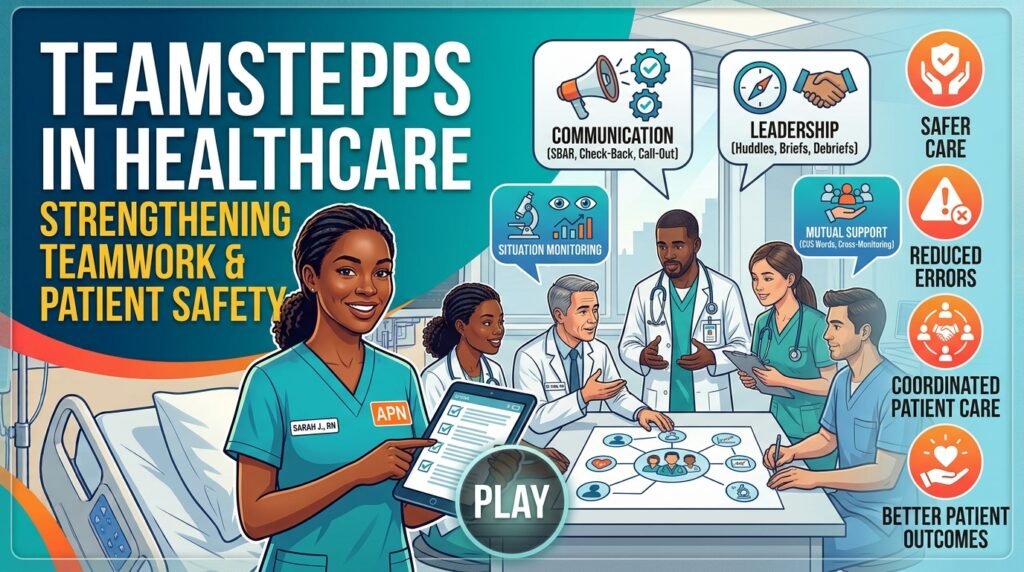
Effective teamwork is essential in healthcare because patient care often involves several professionals working together. Nurses, physicians, pharmacists, therapists, and other healthcare providers must communicate clearly, coordinate their responsibilities, and make informed decisions to achieve positive patient outcomes. However, poor communication, misunderstandings, and unclear roles can affect the quality and safety of care.
TeamSTEPPS provides a structured approach to strengthening teamwork and communication among healthcare professionals. It helps healthcare teams work together more effectively, reduce preventable errors, and improve patient safety.
What Is TeamSTEPPS in Healthcare?
TeamSTEPPS stands for Team Strategies and Tools to Enhance Performance and Patient Safety. It is an evidence-based framework designed to improve communication, teamwork, and collaboration among healthcare professionals.
The framework provides practical strategies and tools that healthcare workers can use to coordinate patient care, share important information, support one another, and respond effectively to changing patient conditions.
TeamSTEPPS focuses on four main teamwork skills: communication, leadership, situation monitoring, and mutual support. These skills help healthcare professionals work as a coordinated team rather than performing their responsibilities independently.
The Four Core Skills of TeamSTEPPS
TeamSTEPPS is built around four essential teamwork skills that support effective healthcare delivery.
1. Communication
Communication involves exchanging accurate, timely, and relevant information among healthcare professionals. Clear communication helps ensure that everyone understands the patient’s condition, treatment plan, and responsibilities.
Examples include:
- Using structured communication tools such as SBAR during patient handovers.
- Confirming verbal instructions to prevent misunderstandings.
- Sharing changes in a patient’s condition promptly.
- Providing clear and accurate information during team discussions.
2. Leadership
Leadership involves guiding healthcare teams, coordinating activities, assigning responsibilities, and ensuring that patient care priorities are addressed.
Effective team leaders encourage participation, provide direction, and help team members understand their roles.
For example, during an emergency, a nurse leader may assign one healthcare worker to monitor vital signs, another to prepare medication, and another to communicate with the physician.
3. Situation Monitoring
Situation monitoring refers to continuously observing the patient, the healthcare environment, and team activities to identify potential problems.
Healthcare professionals use this skill to recognize changes that may affect patient safety and respond before problems become more serious.
For example, a nurse monitoring a postoperative patient may notice a sudden drop in blood pressure and an increase in heart rate. Sharing these findings with the healthcare team allows for timely assessment and intervention.
4. Mutual Support
Mutual support involves helping colleagues, sharing responsibilities when appropriate, and speaking up when patient safety may be at risk.
Healthcare professionals should recognize when team members need assistance and offer support without waiting for problems to escalate.
Examples include:
- Helping another nurse manage a high workload.
- Reminding a colleague about a potential medication safety concern.
- Providing constructive feedback.
- Supporting team members during emergencies.
Important TeamSTEPPS Tools and Strategies
TeamSTEPPS includes practical tools that healthcare professionals can use during everyday patient care.
SBAR: A structured communication method that stands for Situation, Background, Assessment, and Recommendation. It helps healthcare workers communicate important patient information clearly.
Check-back: A communication technique in which the receiver repeats an instruction or message to confirm understanding. The sender then verifies that the information is correct.
Call-out: Sharing important information with the entire team during an urgent situation so that everyone understands what is happening.
Huddle: A short team meeting used to review the current situation, discuss concerns, and adjust the care plan when necessary.
Brief: A meeting held before a task or procedure to establish responsibilities, priorities, and expectations.
Debrief: A discussion after an activity or emergency that allows team members to review what happened, identify challenges, and consider improvements.
CUS words: A method of expressing safety concerns using the phrases “I’m Concerned,” “I’m Uncomfortable,” and “This is a Safety issue.” It helps healthcare professionals speak up when they believe a patient’s safety may be threatened.
Importance of TeamSTEPPS in Healthcare
TeamSTEPPS contributes to safer and more coordinated healthcare by improving how professionals communicate and work together.
- Improves patient safety: Clear communication and shared awareness help reduce misunderstandings and prevent avoidable errors.
- Strengthens teamwork: Healthcare professionals understand their responsibilities and learn to support one another.
- Improves clinical decision-making: Sharing observations and expertise allows teams to make better-informed decisions.
- Promotes timely interventions: Team members can recognize and communicate changes in a patient’s condition more quickly.
- Reduces communication errors: Structured tools help ensure that important patient information is not overlooked.
- Improves staff relationships: Mutual respect, constructive feedback, and open communication promote a positive working environment.
- Supports coordinated care: Healthcare professionals can organize treatment activities and maintain continuity of care.
Examples of TeamSTEPPS in Nursing Practice
TeamSTEPPS can be applied in different healthcare situations.
During patient handovers: A nurse uses SBAR to explain a patient’s diagnosis, current condition, recent changes, and required follow-up care to the incoming nurse.
During a medical emergency: The team leader assigns specific responsibilities while other healthcare professionals communicate their findings through call-outs and check-backs. This helps prevent confusion and delays.
During medication administration: A nurse raises a safety concern after noticing that a prescribed medication may be inappropriate for the patient’s documented allergy. Using CUS words helps communicate the concern clearly.
During shift planning: Nurses hold a brief or huddle to discuss patient priorities, staffing responsibilities, and possible challenges before beginning their duties.
These examples demonstrate how TeamSTEPPS supports communication, shared responsibility, and patient safety in everyday nursing practice.
Challenges in Implementing TeamSTEPPS
Although TeamSTEPPS offers several benefits, healthcare organizations may experience challenges when introducing it.
- Resistance to change: Some healthcare professionals may prefer familiar working methods and be reluctant to adopt new communication practices.
- Hierarchical relationships: Junior staff may feel uncomfortable questioning decisions made by senior professionals.
- Limited training: Healthcare workers may not understand how to apply TeamSTEPPS tools correctly without adequate education and practice.
- Heavy workloads: Staff shortages and demanding schedules may make it difficult to conduct team meetings and debriefings.
- Poor communication culture: Work environments that discourage speaking up can prevent team members from raising safety con