
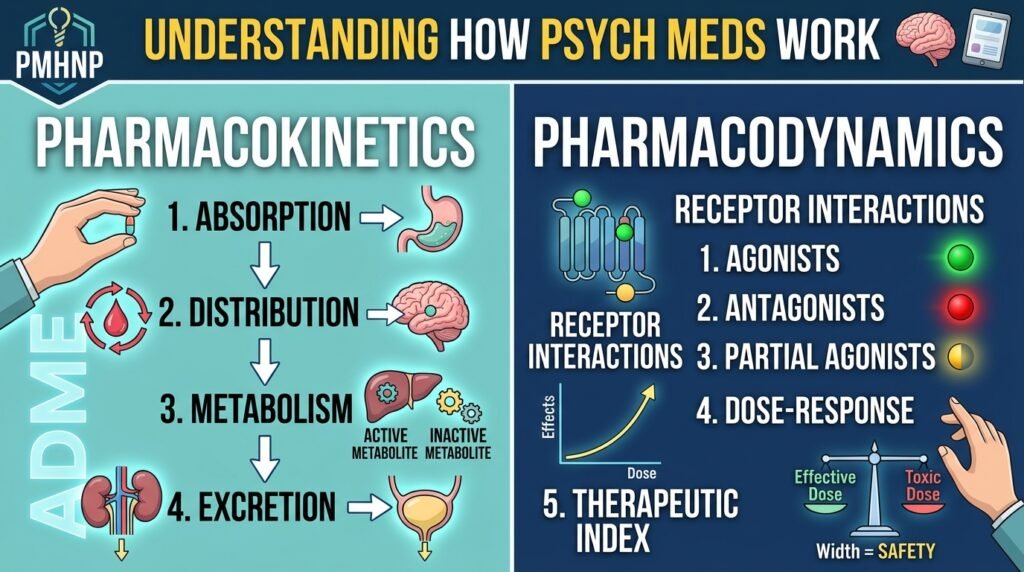
Understanding how psychiatric medications work requires knowledge of how the body processes drugs and how those drugs affect the brain and nervous system. Two important concepts in psychopharmacology are pharmacokinetics and pharmacodynamics. These concepts help explain why medications produce different effects, how long they take to work, how they are eliminated from the body, and why patients may respond differently to the same treatment.
For Psychiatric-Mental Health Nurse Practitioners (PMHNPs), understanding pharmacokinetics and pharmacodynamics is essential for selecting appropriate medications, determining dosing schedules, monitoring treatment effectiveness, and preventing medication-related complications.
What Is Pharmacokinetics in Psychopharmacology?
Pharmacokinetics refers to how the body absorbs, distributes, metabolizes, and eliminates a medication. It describes what happens to a drug after it enters the body and how its concentration changes over time.
In psychiatric practice, pharmacokinetics helps healthcare professionals understand how psychiatric medications reach the brain, how long they remain in the body, and how frequently they may need to be administered.
Pharmacokinetics is commonly explained through four main processes: absorption, distribution, metabolism, and excretion (ADME).
The Four Stages of Pharmacokinetics
1. Absorption
Absorption is the process through which a medication enters the bloodstream from its site of administration.
Psychiatric medications can be administered through different routes, including oral tablets, capsules, liquid formulations, and injections. The route of administration influences how quickly a medication enters circulation.
For example, an oral antidepressant must pass through the digestive system before entering the bloodstream. Some medications are absorbed relatively quickly, while others have formulations designed to release the active ingredient gradually.
Factors that influence absorption include:
- Route of administration.
- Food intake and digestive conditions.
- Medication formulation.
- Blood flow to the absorption site.
- Interactions with other medications.
2. Distribution
Distribution refers to how a medication moves from the bloodstream into different tissues and organs.
For psychiatric medications, distribution is particularly important because many drugs must cross the blood-brain barrier to reach their sites of action in the central nervous system.
The blood-brain barrier is a protective structure that regulates which substances can move from the bloodstream into brain tissue.
Factors affecting drug distribution include:
- Blood flow to different organs.
- Drug solubility, particularly lipid solubility.
- Binding to plasma proteins.
- Ability to cross the blood-brain barrier.
- Body composition and age.
For example, medications that readily cross the blood-brain barrier can reach receptors in the brain and influence neurotransmitter activity.
3. Metabolism
Metabolism refers to the chemical breakdown or modification of medications within the body. It occurs mainly in the liver, although other organs and tissues can also contribute.
Many psychiatric medications are metabolized by liver enzymes belonging to the cytochrome P450 (CYP450) system.
These enzymes help convert medications into substances that can be eliminated from the body. Some medications produce active metabolites that continue to have therapeutic effects.
For example, diazepam is metabolized into active metabolites that can prolong its effects. Fluoxetine also has an active metabolite, norfluoxetine, which contributes to its relatively long duration of action.
Metabolism can be influenced by:
- Liver function.
- Age and genetic differences.
- Other medications that inhibit or induce liver enzymes.
- Alcohol and certain other substances.
- Individual differences in enzyme activity.
These factors are important because changes in metabolism can increase medication concentrations, reduce effectiveness, or increase the risk of adverse effects.
4. Excretion
Excretion is the process through which medications and their metabolites are removed from the body.
The kidneys are the primary organs responsible for eliminating many drugs and their metabolites through urine. Some medications may also be eliminated through bile and feces.
For example, lithium is eliminated almost entirely through the kidneys. Therefore, reduced kidney function can increase lithium concentrations and raise the risk of toxicity.
Factors affecting excretion include:
- Kidney function.
- Age-related changes in renal function.
- Hydration status.
- Drug interactions.
- Changes in urine pH for certain medications.
Monitoring kidney function is particularly important for patients taking medications such as lithium.
What Is Pharmacodynamics in Psychopharmacology?
Pharmacodynamics refers to how a medication affects the body, including its interaction with receptors, neurotransmitters, and other biological targets.
While pharmacokinetics explains what the body does to a medication, pharmacodynamics explains what the medication does to the body.
In psychiatric practice, pharmacodynamics helps explain how medications influence brain activity to produce therapeutic effects or unwanted reactions.
For example, many antipsychotic medications work by blocking dopamine D2 receptors. This reduces dopamine signaling in certain brain pathways and helps manage symptoms such as hallucinations and delusions.
Pharmacodynamic effects depend on factors such as:
- The medication’s mechanism of action.
- The receptors or biological targets affected.
- The strength of receptor binding.
- The medication concentration at its site of action.
- Individual sensitivity to the medication.
Important Concepts in Pharmacodynamics
Several concepts help explain how psychiatric medications produce their effects.
1. Receptor Agonists
An agonist is a medication or substance that binds to a receptor and activates it, producing a biological response.
For example, certain medications activate serotonin receptors to influence mood and other neurological functions.
2. Receptor Antagonists
An antagonist binds to a receptor and blocks or reduces the action of substances that would normally activate it.
For example, many antipsychotic medications act as dopamine D2 receptor antagonists, helping reduce excessive dopamine signaling in relevant brain pathways.
3. Partial Agonists
A partial agonist activates a receptor but produces a weaker response than a full agonist, even when it occupies the available receptors.
For example, aripiprazole acts as a partial agonist at dopamine D2 receptors. It can help regulate dopamine activity rather than simply producing complete receptor activation or blockade.
4. Dose-Response Relationship
The dose-response relationship describes how changes in medication dosage influence the intensity of its effects.
Generally, increasing a medication dose can increase its therapeutic effects up to a certain point. However, higher doses may also increase the risk of adverse effects.
Healthcare professionals must therefore identify an appropriate dose that provides therapeutic benefits while minimizing harm.
5. Therapeutic Index
The therapeutic index describes the relationship between a medication’s toxic dose and its effective dose. It helps indicate how wide or narrow the safety margin of a medication is.
Medications with a narrow therapeutic index require particularly careful dosing and monitoring.
Lithium is an important example in psychiatric practice because the difference between therapeutic and toxic concentrations is relatively small. Regular monitoring of serum lithium levels is therefore necessary.
Difference Between Pharmacokinetics and Pharmacodynamics
Although pharmacokinetics and pharmacodynamics are closely related, they describe different aspects of medication action.
| Pharmacokinetics | Pharmacodynamics |
|---|---|
| Describes what the body does to a medication. | Describes what a medication does to the body. |
| Focuses on absorption, distribution, metabolism, and excretion. | Focuses on drug effects, receptor interactions, and mechanisms of action. |
| Explains how medication concentrations change over time. | Explains how medication concentrations produce biological effects. |
| Helps determine dosing intervals and medication clearance. | Helps explain therapeutic effects and adverse reactions. |
| Example: How the kidneys eliminate lithium. | Example: How lithium influences cellular signaling in the brain. |
Factors That Influence Psychiatric Medication Responses
Patients do not always respond to psychiatric medications in the same way. Differences in pharmacokinetics and pharmacodynamics can influence how quickly a medication works, how effective it is, and whether adverse effects develop.
Important factors include:
- Age: Children and older adults may process medications differently because of developmental or age-related changes in liver and kidney function.
- Genetics: Genetic variations can affect drug-metabolizing enzymes and medication responses.
- Liver and kidney function: Impaired organ function may alter medication metabolism or elimination, increasing the risk of drug accumulation.
- Drug interactions: Some medications inhibit or induce drug-metabolizing enzymes, changing the concentration or effects of other medications.
- Body composition: Differences in body fat and body water can influence the distribution of certain medications.
- Medication adherence: Missed doses, incorrect administration, or abrupt discontinuation can affect medication concentrations and treatment outcomes.
- Individual sensitivity: Patients may experience different therapeutic effects and adverse reactions even when taking similar doses.
Clinical Importance of Pharmacokinetics and Pharmacodynamics in Psychiatric Nursing
Understanding these concepts helps psychiatric healthcare professionals make safer and more informed medication decisions.
Their clinical importance includes:
- Supporting appropriate dosing: Understanding how medications are processed helps determine suitable doses and administration intervals.
- Preventing medication toxicity: Recognizing factors that affect metabolism and excretion helps identify patients at risk of drug accumulation.
- Understanding treatment response: Pharmacodynamic knowledge helps explain why certain medications improve specific psychiatric symptoms.
- Identifying drug interactions: Understanding metabolic pathways helps healthcare professionals recognize interactions that may alter medication effectiveness or safety.
- Supporting medication monitoring: Monitoring drug levels, kidney function, liver function, and clinical symptoms helps evaluate treatment safety.
- Promoting individualized treatment: Considering patient-specific factors helps healthcare professionals select and adjust medications appropriately.
Role of Psychiatric-Mental Health Nurse Practitioners
Psychiatric-Mental Health Nurse Practitioners use pharmacokinetic and pharmacodynamic knowledge when assessing patients and managing psychiatric medication treatment.
Their responsibilities include:
- Evaluating patient history: Reviewing medical conditions, current medications, allergies, and previous treatment responses before recommending medication.
- Selecting appropriate medications: Considering drug mechanisms, metabolism, potential interactions, and individual patient characteristics.
- Monitoring therapeutic effects: Assessing changes in psychiatric symptoms and determining whether the medication is achieving its intended purpose.
- Identifying adverse effects: Recognizing unwanted medication reactions and determining when further assessment or treatment adjustments are necessary.
- Monitoring laboratory results: Reviewing relevant tests, including lithium levels, kidney function, and liver function, depending on the medication prescribed.
- Educating patients: Explaining medication instructions, expected effects, potential side effects, and the importance of taking medications as prescribed.
- Adjusting treatment when appropriate: Making evidence-based medication changes while considering the patient’s response, safety, and treatment goals.
Note!
- Pharmacokinetics describes how the body absorbs, distributes, metabolizes, and eliminates psychiatric medications.
- The four main pharmacokinetic processes are absorption, distribution, metabolism, and excretion (ADME).
- Pharmacodynamics explains how medications interact with receptors and biological targets to produce therapeutic and adverse effects.
- Important pharmacodynamic concepts include agonists, antagonists, partial agonists, dose-response relationships, and therapeutic index.
- Age, genetics, organ function, drug interactions, and medication adherence can influence psychiatric medication responses.
- PMHNPs use pharmacokinetic and pharmacodynamic knowledge to guide medication selection, dosing, monitoring, and patient education.