
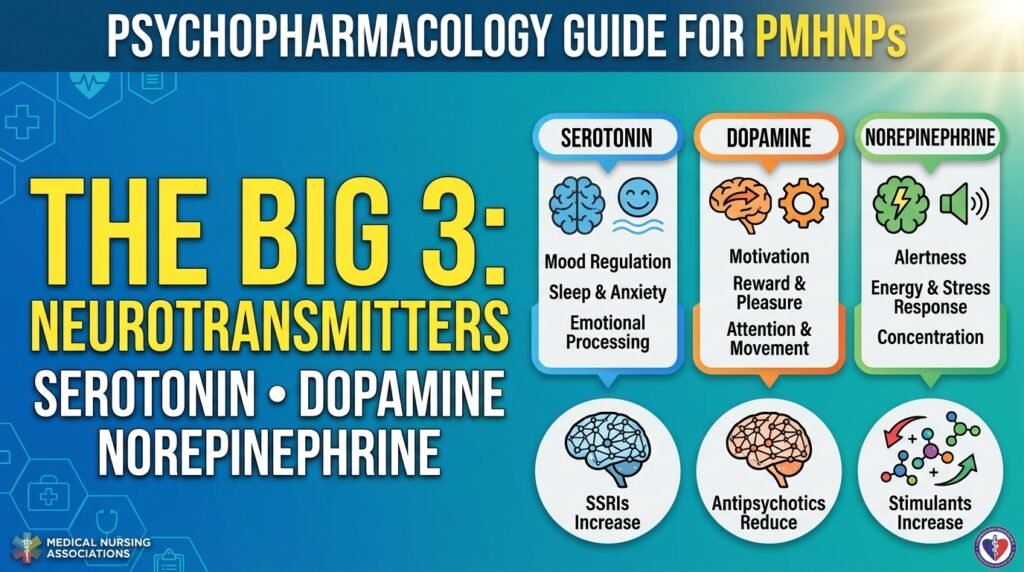
The brain relies on chemical messengers called neurotransmitters to regulate mood, emotions, attention, motivation, sleep, and behavior. Among the most important neurotransmitters studied in psychiatric mental health practice are serotonin, dopamine, and norepinephrine. These chemicals help nerve cells communicate and influence several functions that affect psychological well-being.
Changes in neurotransmitter signaling are associated with different mental health conditions, including depression, anxiety disorders, schizophrenia, and attention-deficit/hyperactivity disorder (ADHD). Many psychiatric medications work by modifying the activity of these neurotransmitter systems to improve symptoms and support mental functioning.
For Psychiatric-Mental Health Nurse Practitioners (PMHNPs), understanding serotonin, dopamine, and norepinephrine is important for understanding psychiatric medication mechanisms, evaluating treatment responses, and providing appropriate patient care.
What Are Serotonin, Dopamine, and Norepinephrine?
Serotonin, dopamine, and norepinephrine are chemical messengers that transmit signals between nerve cells in the brain and nervous system. Each neurotransmitter has different functions, although their activities overlap and interact.
They influence several processes, including emotional regulation, motivation, attention, stress responses, and sleep.
Understanding their individual roles helps explain why different psychiatric medications target particular neurotransmitter systems.
1. Serotonin: Its Role in Mood and Emotional Regulation
Serotonin, also known as 5-hydroxytryptamine (5-HT), is a neurotransmitter involved in regulating mood, sleep, appetite, emotional processing, and other physiological functions.
Most serotonin in the body is found outside the brain, particularly in the gastrointestinal system. However, serotonin signaling within the central nervous system plays an important role in mental health.
Functions of Serotonin
Serotonin contributes to several important functions:
- Mood regulation: Helps regulate emotional responses and mood stability.
- Sleep: Participates in sleep-wake regulation and influences the production of melatonin.
- Appetite: Helps regulate hunger and feelings of fullness.
- Emotional processing: Influences how individuals respond to emotions and stressful situations.
- Anxiety regulation: Serotonin signaling is involved in brain circuits associated with fear and anxiety.
- Cognitive functioning: Contributes to learning, memory, and other cognitive processes.
Serotonin and Mental Health Conditions
Alterations in serotonin signaling have been studied in several psychiatric conditions, particularly depression and anxiety disorders.
However, mental health conditions cannot be explained by simply having too little or too much serotonin. They involve complex interactions among neurotransmitter systems, brain circuits, genetics, environmental influences, and other biological factors.
Psychiatric Medications That Affect Serotonin
Several psychiatric medications influence serotonin signaling.
Selective serotonin reuptake inhibitors (SSRIs): These medications block serotonin reuptake, increasing its availability in the synaptic space. Examples include fluoxetine, sertraline, and escitalopram.
Serotonin-norepinephrine reuptake inhibitors (SNRIs): These medications inhibit the reuptake of serotonin and norepinephrine. Examples include venlafaxine and duloxetine.
Serotonin receptor medications: Some medications act directly on specific serotonin receptors. For example, buspirone is a partial agonist at serotonin 5-HT1A receptors and is used to treat anxiety.
2. Dopamine: Its Role in Motivation, Reward, and Attention
Dopamine is a neurotransmitter involved in motivation, reward, pleasure, movement, learning, and attention. It helps individuals recognize rewarding experiences, develop motivation, and regulate certain behaviors.
Dopamine also plays an important role in several brain pathways that influence thinking, movement, and emotional responses.
Functions of Dopamine
Dopamine contributes to the following functions:
- Motivation: Supports the drive to pursue goals and complete activities.
- Reward and pleasure: Helps process rewarding experiences and reinforce behaviors.
- Attention: Contributes to concentration and the ability to maintain focus.
- Movement: Helps regulate voluntary muscle movements and coordination.
- Learning: Participates in learning through reinforcement and feedback.
- Emotional processing: Influences aspects of emotional responses and behavior.
Dopamine and Mental Health Conditions
Dopamine signaling is associated with several psychiatric and neurological conditions.
Schizophrenia: Increased dopamine signaling in certain brain pathways is associated with positive symptoms such as hallucinations and delusions. However, schizophrenia involves several biological systems, not dopamine alone.
ADHD: Dopamine signaling contributes to attention, motivation, and executive functioning. Differences in dopamine-related pathways are involved in ADHD.
Depression: Dopamine pathways are associated with motivation, reward processing, and the ability to experience pleasure. Changes in these systems may contribute to symptoms such as reduced motivation and anhedonia.
Psychiatric Medications That Affect Dopamine
Different psychiatric medications influence dopamine activity in different ways.
Antipsychotics: Many antipsychotic medications block dopamine D2 receptors, reducing dopamine signaling in particular brain pathways. Examples include haloperidol, risperidone, and olanzapine.
Stimulants: Medications such as methylphenidate and amphetamine-based drugs increase dopamine and norepinephrine signaling. They are commonly used to manage ADHD.
Dopamine partial agonists: Aripiprazole acts as a partial agonist at dopamine D2 receptors, helping regulate dopamine activity.
3. Norepinephrine: Its Role in Alertness, Attention, and Stress Response
Norepinephrine, also known as noradrenaline, is a neurotransmitter that helps regulate alertness, attention, energy, and the body’s response to stress.
It functions in both the central nervous system and the sympathetic nervous system. In the brain, it is particularly important for maintaining attention and responding to changes in the environment.
Functions of Norepinephrine
Norepinephrine contributes to several important functions:
- Alertness: Helps maintain wakefulness and awareness.
- Attention: Supports concentration and the ability to respond to important information.
- Energy: Influences mental alertness and activity levels.
- Stress response: Helps the brain respond to challenging or threatening situations.
- Memory: Contributes to the formation and retrieval of certain memories, particularly those associated with emotional experiences.
- Mood regulation: Participates in brain processes involved in emotional regulation.
Norepinephrine and Mental Health Conditions
Changes in norepinephrine signaling are associated with several psychiatric conditions.
Depression: Altered norepinephrine signaling may contribute to symptoms such as fatigue, reduced concentration, and low energy.
ADHD: Norepinephrine plays an important role in attention and executive functioning. Medications that increase its signaling can improve certain ADHD symptoms.
Anxiety disorders: Norepinephrine is involved in the body’s arousal and stress-response systems. Increased activation of these systems may contribute to physical symptoms such as rapid heartbeat, sweating, and heightened alertness.
Psychiatric Medications That Affect Norepinephrine
Several psychiatric medications influence norepinephrine activity.
SNRIs: Venlafaxine and duloxetine inhibit the reuptake of serotonin and norepinephrine.
Norepinephrine reuptake inhibitors: Atomoxetine selectively inhibits norepinephrine reuptake and is used to treat ADHD.
Certain atypical antidepressants: Bupropion affects norepinephrine and dopamine signaling and is used to treat depression.
Differences Between Serotonin, Dopamine, and Norepinephrine
Although these neurotransmitters interact, each has different primary functions and medication-related effects.
| Neurotransmitter | Main Functions | Related Psychiatric Conditions | Examples of Medications |
|---|---|---|---|
| Serotonin | Mood, sleep, appetite, emotional regulation | Depression and anxiety disorders | Fluoxetine, sertraline, escitalopram |
| Dopamine | Motivation, reward, attention, movement | Schizophrenia, ADHD, depression | Haloperidol, aripiprazole, methylphenidate |
| Norepinephrine | Alertness, attention, energy, stress response | Depression, ADHD, anxiety disorders | Venlafaxine, duloxetine, atomoxetine |
How Do These Neurotransmitters Work Together?
Serotonin, dopamine, and norepinephrine do not function independently. They interact through connected brain pathways to regulate mood, motivation, attention, emotional responses, and behavior.
For example, a person experiencing depression may have difficulties with mood, concentration, motivation, and energy. These symptoms may involve changes in several neurotransmitter systems rather than one chemical messenger alone.
Similarly, a person with ADHD may experience difficulties with attention and impulse control involving dopamine and norepinephrine signaling.
This interaction explains why some psychiatric medications affect more than one neurotransmitter system and why treatment responses differ among individuals.
Importance of Understanding Neurotransmitters in Psychopharmacology
Understanding serotonin, dopamine, and norepinephrine helps psychiatric healthcare professionals connect medication mechanisms with mental health symptoms and treatment outcomes.
This knowledge is important for several reasons:
- Understanding medication mechanisms: Helps explain how antidepressants, antipsychotics, and ADHD medications influence brain signaling.
- Supporting medication selection: Provides a scientific foundation for understanding why particular medication classes are used for different psychiatric conditions.
- Recognizing adverse effects: Helps healthcare professionals understand potential effects associated with modifying neurotransmitter activity.
- Evaluating treatment responses: Supports assessment of changes in mood, attention, sleep, motivation, and other symptoms.
- Improving patient education: Helps nurses explain how psychiatric medications work and why treatment may take time to produce noticeable benefits.
- Promoting safe medication management: Supports recognition of potential drug interactions and medication-related complications.
Role of Psychiatric-Mental Health Nurse Practitioners
Psychiatric-Mental Health Nurse Practitioners use knowledge of neurotransmitter systems when assessing patients, selecting medications, and monitoring psychiatric treatment.
Their responsibilities include:
- Conducting psychiatric assessments: Evaluating symptoms related to mood, attention, motivation, sleep, and behavior.
- Understanding medication mechanisms: Recognizing how prescribed medications influence serotonin, dopamine, and norepinephrine signaling.
- Selecting appropriate treatments: Considering the patient’s diagnosis, medical history, previous medication responses, and treatment goals.
- Monitoring therapeutic outcomes: Assessing improvements in psychiatric symptoms and overall functioning.
- Identifying adverse effects: Monitoring for medication-related complications, including movement disorders, excessive sedation, and symptoms of serotonin syndrome.
- Educating patients: Explaining medication purposes, expected benefits, possible side effects, and the importance of following treatment instructions.
- Individualizing treatment: Adjusting treatment approaches according to clinical findings, patient preferences, and medication tolerability.
Note!
- Serotonin, dopamine, and norepinephrine are neurotransmitters involved in regulating mood, motivation, attention, sleep, and behavior.
- Serotonin contributes to mood regulation, sleep, appetite, and emotional processing.
- Dopamine plays an important role in motivation, reward, movement, attention, and learning.
- Norepinephrine supports alertness, concentration, energy, and the stress response.
- Psychiatric medications influence these neurotransmitters through different mechanisms, including reuptake inhibition and receptor blockade.
- These neurotransmitter systems interact, meaning mental health conditions cannot be explained by a single chemical imbalance.
- PMHNPs use knowledge of neurotransmitters to understand medication mechanisms, monitor treatment outcomes, and promote safe psychiatric care.