
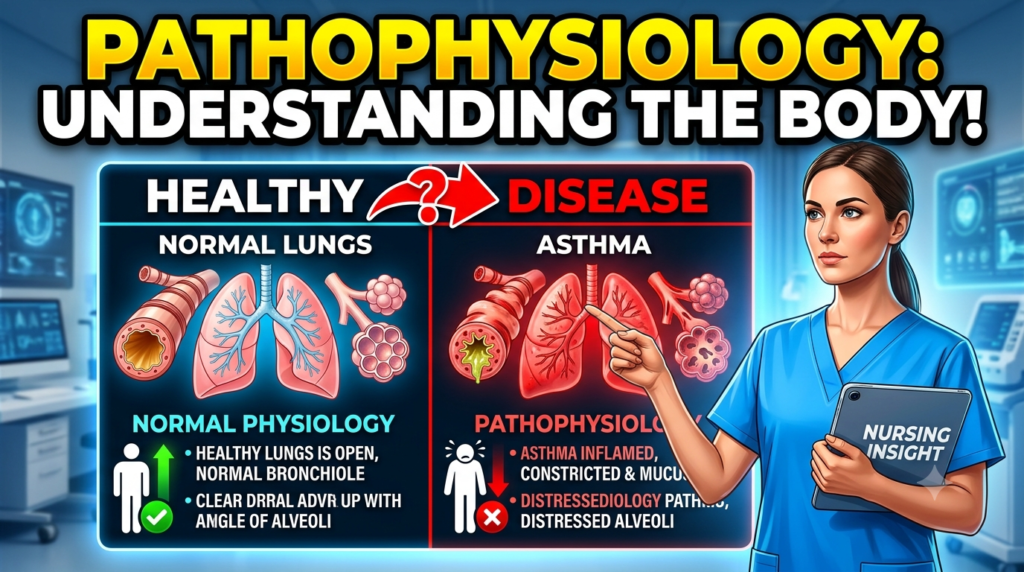
Topic: Pathophysiology
Understanding how diseases affect the human body is one of the most important aspects of nursing and healthcare. Healthcare professionals must not only recognize the signs and symptoms of illness but also understand the biological changes that cause them. This knowledge enables nurses to assess patients accurately, make informed clinical decisions, and provide safe, evidence-based care throughout the treatment process.
Definition of Pathophysiology
Pathophysiology is the branch of medical science that studies the functional changes in the body caused by disease, injury, or abnormal conditions. It combines knowledge of pathology, which focuses on the causes and effects of disease, and physiology, which examines how the body’s systems normally function. By comparing normal body functions with abnormal changes, pathophysiology explains how diseases develop, progress, and produce specific signs and symptoms.
Understanding pathophysiology helps healthcare professionals identify disease mechanisms, predict complications, interpret diagnostic findings, and select appropriate treatment approaches. Rather than simply memorizing diseases, nurses use pathophysiological principles to understand why a patient becomes ill and how the body responds during the disease process.
Components of Pathophysiology
1. Etiology
Etiology refers to the cause or origin of a disease. Diseases may develop due to genetic factors, infections, environmental exposures, lifestyle habits, nutritional deficiencies, or trauma. Identifying the cause helps healthcare providers determine appropriate treatment and prevention strategies.
2. Pathogenesis
Pathogenesis describes the sequence of events that occur from the beginning of a disease until its clinical manifestations appear. It explains how a disease develops, progresses, and affects body tissues and organs over time.
3. Clinical Manifestations
Clinical manifestations are the signs and symptoms that result from changes within the body during disease. Signs are objective findings observed by healthcare professionals, while symptoms are subjective experiences reported by patients.
4. Complications
Complications are additional health problems that develop as a result of the primary disease. Understanding potential complications helps nurses monitor patients closely and intervene early to prevent further harm.
Importance of Studying Pathophysiology
- Helps nurses understand how diseases develop and progress.
- Explains the relationship between normal body function and disease.
- Improves clinical reasoning and critical thinking.
- Supports accurate patient assessment and diagnosis.
- Guides appropriate nursing interventions and care planning.
- Helps predict disease complications and patient outcomes.
- Strengthens evidence-based nursing practice.
- Improves communication among healthcare professionals.
Applications of Pathophysiology in Nursing
Pathophysiology is applied in every area of nursing practice. Nurses use it to understand why patients experience certain symptoms, interpret laboratory and diagnostic test results, monitor disease progression, and evaluate treatment effectiveness. This knowledge enables nurses to provide individualized, safe, and effective patient care.
It also plays an important role in nursing education, research, and evidence-based practice. By understanding disease mechanisms, nurses can educate patients about their conditions, promote disease prevention, and participate in developing better healthcare interventions.
Examples of Pathophysiology
- In diabetes mellitus, reduced insulin production or insulin resistance causes elevated blood glucose levels, leading to complications such as nerve damage and kidney disease.
- In asthma, inflammation and narrowing of the airways make breathing difficult and may cause wheezing and shortness of breath.
- In heart failure, the heart cannot pump blood efficiently, reducing oxygen delivery to body tissues and causing fatigue, swelling, and fluid accumulation.
Note
- Pathophysiology is the study of how diseases affect normal body function.
- It combines knowledge of pathology and physiology to explain disease processes.
- Understanding pathophysiology helps nurses recognize signs and symptoms, provide effective care, and prevent complications.
- Knowledge of pathophysiology is essential for patient assessment, diagnosis, treatment planning, and evidence-based nursing practice.